I Turned Our Tiny Suburban Lot Into a Pretty Vegetable Garden (Without the Pinterest Perfection)
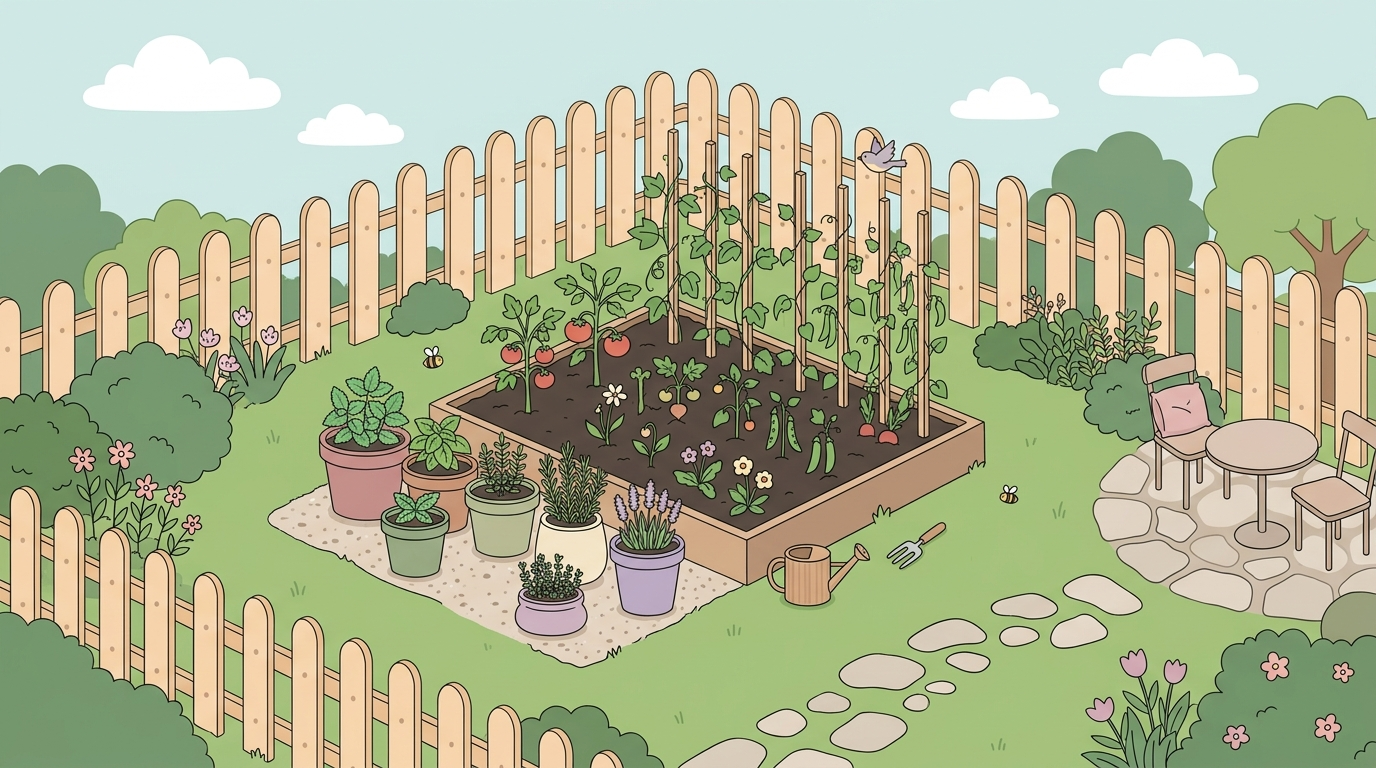
If you want a small space vegetable garden that has some kind of design aesthetic beyond “pile of tomato cages,” vertical is where you start. Not because it looks good on its own—it doesn’t, not automatically—but because it solves two problems at once: you get more growing surface without expanding your footprint, and the visual structure it adds does a lot of the design work for you. I figured this out backwards, after spending a stupid amount of time trying to make a flat, crowded 4×8 bed look intentional, and failing.
Before we moved out to Tennessee I had a small suburban backyard, and that’s where I started gardening. The small space vegetable garden design aesthetic obsession started there, honestly—I wanted something that looked like it belonged in a magazine but also actually produced food. Those two things are harder to reconcile than anyone on Instagram admits.
TL;DR: Vertical structures, mulch color, and negative space do more visual work than matching containers. Dense planting and good-looking planting are in constant tension. There’s no clean resolution. You will spend more money than you plan to.
The vertical thing actually works
Start here, before you do anything else. Vertical growing changes how a small bed reads—it gives the eye somewhere to go besides “flat square of dirt.”
- Cattle panel arches over beds. A single 16-foot cattle panel bent into an arch over a raised bed and staked with T-posts costs around $30 at Tractor Supply and lasts for years. Grow cucumbers, pole beans, or small squash up it. The arch shape reads as structure even when the plants are small. Ben built two of these in an afternoon and they are genuinely the best-looking things in our garden, which annoys me because he did not measure anything.
- Wall-mounted planters on fences or structures. Metal pocket planters screwed into a fence board work for herbs, lettuce, and strawberries. A six-pocket set runs about $25-40. Mount them at two or three heights so you get a layered look instead of a flat row. These dry out fast, which we’ll get to later.
- Stacking pot systems for compact footprint. A tiered strawberry planter or stackable herb tower fits in about two square feet of ground space and grows six to twelve plants. The visual weight is vertical instead of horizontal, which reads as intentional even when it’s chaotic.
- Bamboo or wood teepees for climbers. Six bamboo stakes tied at the top costs almost nothing and looks significantly better than a wire tomato cage. Grow pole beans or sweet peas up them. The geometry does the design work.
- Trellised cucumbers against a wall or fence. Horizontal wire strung between eye hooks, spaced 6 inches apart, gives cucumbers a clean surface to climb and keeps them readable. The University of Tennessee Extension has good variety guides for cucumbers that do well in Zone 7a—worth checking before you buy seeds because not all varieties trellis well.
What happened when we tried to make it ‘cohesive’
Our second spring in the suburban house I bought eight matching terracotta-colored resin planters, two cans of the same sage green spray paint for the fence sections, and a bundle of matching plant labels. I had a mood board. I was going to have the garden I had been looking at on Pinterest for three years.
By July, the matching planters were distributed around the yard based on where I needed them, not where they looked good. Three were tucked behind the shed. The painted fence faded unevenly because I used exterior paint on old pressure-treated wood and didn’t prime it, so the color went patchy in about six weeks. The plant labels were gone by week two—knocked over by rain, stolen by something, I genuinely don’t know.
The thing is, the garden didn’t look worse than before. It looked basically the same, maybe a little better in some spots, but not in the way the matching containers were supposed to achieve. The money I spent on the containers was fine—they’re useful—but the design payoff was zero. The plants themselves, once they grew in, created the visual interest. The containers just held them.
What I learned: the plants are the design. The containers are infrastructure. Matching infrastructure doesn’t make the plants look better.
Design tricks that cost almost nothing
- Mulch color matters more than you think. Black rubber mulch looks sleek and modern. Brown bark mulch reads as natural. Light-colored gravel reads as formal. The mulch color is the background your plants sit against, and it affects the whole look. We use dark brown bark mulch in the kitchen garden beds and it makes everything look cleaner. Probably costs $5-8 per bag, and a standard raised bed needs about two bags to get a 2-inch layer.
- Plant in odd numbers and clusters, not rows. Three basil plants together looks like a decision. Six basil plants in a row looks like a farm operation. Even in a 4×4 bed, grouping plants in threes or fives creates visual weight that reads as designed.
- Use hardscape to frame beds. A single row of bricks, a timber edge, or even a line of larger stones around the perimeter of a bed gives it a boundary. The eye reads that boundary as structure. It’s the cheapest design move available.
- Negative space strategy. Leave one section of a bed deliberately open or mulched rather than planted. This is hard when you want to maximize production, but a single empty corner makes the planted sections look more deliberate. I can do this for maybe three weeks before I fill it with something.
- Height variation in the same bed. Put tall plants at the back or center, medium in the middle, low spreaders at the edges. This is just standard planting practice, but it’s also the main reason some beds look designed and others look random.
- Repeat one element. Pick one plant—marigolds, a specific herb, a flowering kale—and put it in multiple beds or containers. Repetition creates cohesion without matching containers or coordinated colors.
But does it actually look better, or do I just think it does?
I spend a lot of time looking at my garden. Probably more than any garden warrants. And I genuinely can’t tell anymore whether I think it looks good because it looks good, or because I’m used to it and I’m attached to it and I’ve put a lot of work into it.
My neighbor walked over once—she’s been gardening for thirty years, has an actual beautiful yard with a cutting garden and espaliered apple trees—and she said it looked “productive.” Not beautiful. Productive. And I’ve been thinking about that word ever since.
There might not be a way to have a vegetable garden that looks the way a flower garden looks. The plants don’t stay. The seasons change what’s there every few weeks. By August the tomatoes are sprawling past their cages, the squash is taking over two square feet of path, and any design you put in place in May is just gone. The bones might still be there—the raised bed frames, the cattle panel arches, the mulch paths—but the plants stopped cooperating months ago.
I don’t have an answer to whether any of the aesthetic choices actually matter. I think they matter to me. I’m not sure they’re visible to anyone else.
The spacing problem we still haven’t solved
Productive planting and visually appealing planting are in direct conflict, and nobody fully admits this.
Intensive planting—the kind that maximizes yield from a small space, following something like the Square Foot Gardening approach by Mel Bartholomew—fills every inch. No negative space. Plants touching by midsummer. It works for production. It looks, by mid-July, like controlled chaos.
“Breathing room” planting, where you leave real space between plants, looks better for longer. But you’re growing less food per square foot, and in a small space that’s a real tradeoff.
We’ve tried going to half-spacing—not the full square foot grid, but not the wide-row spacings either. The plants still touch by midsummer. We tried limiting ourselves to one or two statement plants per bed with lower plants around them. Better, but we ran out of space for everything we wanted to grow. This year I’m trying to keep one dedicated bed as a “display bed” with more spacing and only photogenic plants (rainbow chard, purple basil, mixed lettuces) and using the other beds for maximum production regardless of how they look. That might be the answer. We’re in late spring and I don’t know yet.
Ben’s position is that I should stop worrying about it, which is correct and useless simultaneously.
Why containers ruin everything (and also save it)
Earlier I said vertical growing and wall-mounted planters are good. They are. But containers are also genuinely annoying in ways I didn’t appreciate when I was enthusiastic about them.
They dry out constantly. In Tennessee summers, a small pot in full sun needs water twice a day in July and August. If you miss a day, the basil wilts and sets seed and it’s over. The wall-mounted pocket planters I mentioned are charming and they are a watering commitment I was not prepared for. They need checking every single day from June through September.
They’re expensive to do right. A good-quality fabric grow bag or a thick resin planter that doesn’t crack in heat runs $15-40 per container. Cheap containers either degrade in UV light within two seasons or leach something into the soil (though the Purdue Extension has done some work on container material safety if you want to go down that rabbit hole). To fill a 15-gallon container with decent potting mix—not garden soil, which compacts—you need at least two cubic feet of mix, which is about $10-15 per bag, and you need more than one bag. Per container. It adds up.
And yet. In a small space, containers let you put growing surface anywhere—on a porch, on a patio, on top of a wall, in a corner with no soil access. They’re movable. They let you grow things in soil conditions you can actually control instead of whatever is in the ground. For a small space, they are still the most flexible option available.
I’ve just stopped pretending they’re low-maintenance. They are not. The Old Farmer’s Almanac has a solid primer on container vegetable gardening if you want an overview of what actually grows well in them—some plants just don’t work in pots regardless of how you care for them.
I still spend too much money on this
Every spring I tell myself I’m going to keep costs down. Every summer I look at what I’ve spent and it’s not what I planned.
This year: two new cattle panels ($60), a bag of slow-release container fertilizer because I kept forgetting to liquid feed ($22), three terracotta pots I didn’t need but they were at the farm store and they looked right ($38), a soil moisture meter because I thought it would help me water less and I’ve used it twice ($18), and a flat of herbs from the nursery because I started my own from seed and they were too small by transplant time ($27).
That’s $165 before I bought a single seed packet. Seeds and potting mix are on top of that.
I don’t have a solution. I have a number I try to stay under each season and I don’t stay under it. The design choices specifically—the containers, the decorative mulch, the nice lumber for bed edging instead of whatever scrap is around—are where the money goes. You can grow vegetables cheaply. Growing vegetables in a way that looks like you thought about it costs more. That’s just true and I haven’t found a way around it.
If there’s one thing worth taking from all of this: put your money into vertical structures first. The cattle panel arch or a simple trellis system gives you the most design return for the least cost, and it actually increases yield at the same time. Everything else is optional and gets expensive fast.