Why My First Batch of Pickles Failed (And the Best Canning Recipes for Pickles and Relish I Use Now)
Three to one. That’s the acid-to-water ratio that matters more than any recipe you’ll find when it comes to pickling. I spent a lot of time in my second summer out here hunting down the best canning recipes for pickles and relish, downloading PDFs, bookmarking forums, filling pages in my garden journal with notes I couldn’t read a week later. And the thing I kept missing was this: the recipes aren’t where the knowledge lives. The principles are.
Once I understood that, pickling got boring in the best way. Consistent. Repeatable. I stopped ruining jars.
Acid, salt, heat—that’s the whole game
Acid stops bacterial growth. Salt pulls moisture out of the vegetable and helps preserve texture. Heat seals the jar and finishes the process. That’s it. Every pickle recipe you’ll ever read is just a variation on those three things working together.
The National Center for Home Food Preservation publishes tested recipes, and what makes a recipe “tested” is that someone confirmed those three variables are in the right proportions to make the food safe. Vinegar needs to be at least 5% acidity—that’s the minimum. Most white distilled vinegar is labeled 5%, and that’s what I use for anything where I care about color. Apple cider vinegar works too but will darken light cucumbers. Don’t use anything with unknown or variable acidity, like homemade vinegars.
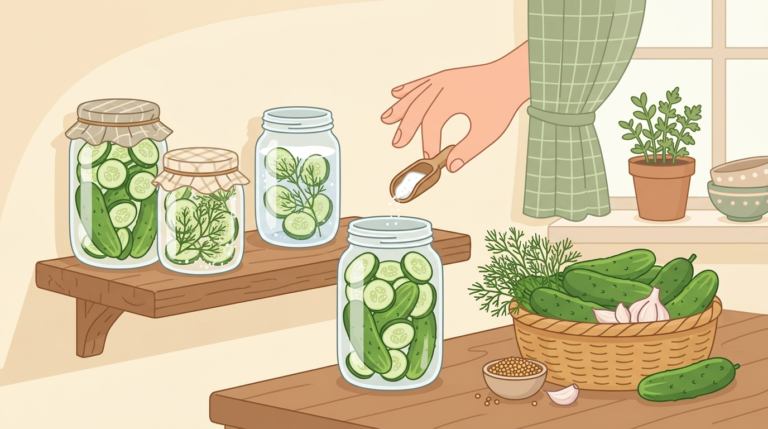
Salt matters for texture more than safety in fresh-pack pickles. Too little and your cucumbers go soft. I use pickling salt, not table salt. The iodine in table salt can discolor your brine and make things mushy. A five-pound bag of pickling salt from the canning aisle runs about four dollars and lasts two seasons.
Heat is non-negotiable for water-bath canning. Ten minutes in a boiling water bath for most pickle recipes, though you’ll adjust for elevation. Here in Tennessee at low elevation, ten minutes is standard. If you’re higher up, add two minutes per thousand feet.
How to avoid the biggest pickle-canning mistake most people make
Soft, mushy pickles. That’s the one. Not unsafe—just sad. Here’s what causes it and how to stop it from happening:
- Cut off the blossom end of every cucumber. The blossom end contains enzymes that cause softening. Just take off a thin slice. Easy, easy, easy—but nobody mentions it in recipes.
- Use fresh cucumbers, picked small. Ideally process within 24 hours of picking. The longer they sit, the softer they get before the brine ever touches them. Pickling cucumbers, not slicers. Straight Eight is a slicer. Kirby or National Pickling cucumbers are what you want.
- Don’t skip the ice bath soak. Before packing, soak your cucumbers in ice water for two hours. This firms them up. I do this in a big stock pot in the sink.
- Don’t process longer than the recipe says. More time in the water bath does not mean more safe. It means softer pickles. Set a timer.
- Add a tannin source. A grape leaf, a few oak leaves, or a small amount of black tea in the jar adds tannins that help maintain crunch. I use a grape leaf from the wild vine growing along our fence line. One per jar.
These five things together will solve about 90% of texture problems. The other 10% is probably your cucumber variety.
Relish is easier than you think, but also kind of sloppy
Relish is forgiving because you chop everything up small anyway, so texture consistency matters less. Overcooked a little? Fine. Vegetables weren’t perfectly fresh? Usually still fine. That said, relish is also weirdly inconsistent in ways I haven’t fully figured out.
Some batches of my cucumber-dill relish come out bright and sharp. Others taste flat even when I use the same recipe, the same vinegar, the same garden. I’ve tried adjusting the sugar, the dill, the processing time. No clear answer yet.
What I do know: relish needs to drain. After you chop your cucumbers and onions, toss them with pickling salt and let them sit for two hours minimum. Then rinse and drain really well. If you skip this step, the relish is watery and the flavor never concentrates the way it should. A fine-mesh strainer and some patience is all it takes.
Green tomato relish made with the end-of-season tomatoes that won’t ripen is probably the most useful thing I make. We get hit with frost in mid-October most years, and that last green tomato haul goes straight into relish. It disappears fast at the farmers market too, which Ben loves to point out because he’s the one who volunteered us to have a table there in the first place.
Relish is forgiving because you chop everything up small anyway—but I’ve made twenty batches and I still can’t fully predict how the flavor will land.
I still don’t understand why my dill pickles work and my bread-and-butters don’t
My dill pickles are good. Reliably good. People ask me for the recipe and I give it to them and they come back and say theirs weren’t the same, and I don’t know what to tell them because I’m not sure I understand why mine work either.
My bread-and-butter pickles, on the other hand, come out too sweet about half the time. I’ve reduced the sugar. I’ve switched vinegar. I’ve tried different cucumber varieties. Sometimes a batch is perfect—tangy, snappy, good on a burger. The next batch from the same week’s cucumbers will be cloying and weird. No obvious reason.
I’ve read that the sugar-to-acid ratio in sweet pickles is more sensitive than in dill, and that small variations in cucumber water content can shift the balance. That explanation makes some sense. But I haven’t solved it. I just make more dill pickles and accept that bread-and-butters are a gamble.
If you’ve got this figured out, I’m genuinely interested. I’ve been at this for two seasons and I’ve accepted that some things just don’t resolve cleanly.
What actually happened that first August
It wasn’t a disaster. It was more boring than that. I made eight jars of dill pickles in our first summer here, followed a recipe I found online, and when we opened the first jar two weeks later they were soft, brownish, and tasted like vinegar without tasting like anything else. Not unsafe—just not good.
I had used table salt instead of pickling salt. I hadn’t soaked the cucumbers. I’d used older cucumbers from the store because our garden wasn’t producing yet. And I’d used a generic recipe from a site that didn’t specify vinegar acidity. I made basically every mistake at once, which meant I couldn’t figure out which one caused the problem.
Ben said “they’re fine” and ate three slices to prove it. He’s not wrong that they were safe. But fine isn’t what I was going for.
The following summer I started over with a tested recipe from the USDA, bought actual pickling cucumbers, and used pickling salt. The difference was immediate and obvious. That’s the whole story. It wasn’t a crisis. It was just not knowing the basics yet.
The recipes don’t matter as much as you think (but they still kind of matter)
I opened this by saying the principles matter more than the recipes. I stand by that. But I also want to be honest: for canning, you should still follow a tested recipe, at least until you understand why it’s built the way it is.
Here’s the difference. The recipe tells you what to do. The principles tell you why. Once you know why, you can adapt a recipe—different herbs, different vegetables, different jar sizes—without accidentally making something unsafe. You cannot just swap brine ratios based on taste preference, because the acid level isn’t just about flavor. It’s about pH and food safety.
So: follow tested recipes from the National Center for Home Food Preservation or the Ball Blue Book (the current edition, not a copy from 1987 you found at a sale). Don’t change the amount of vinegar or water. Do experiment with spices, garlic quantities, dill versus dill seed. That’s where your pickles become yours without compromising anything that matters.
The Ball Blue Book runs about twelve dollars. It’s the one resource I’d tell every first-time canner to buy before anything else, including jars.
- Table salt instead of pickling salt—discolored the brine and made things mushy
- Store cucumbers that had been sitting too long—texture was already compromised before canning
- Using a recipe that didn’t specify vinegar acidity percentage
- Skipping the ice bath soak because it seemed unnecessary
- Processing longer than recommended thinking more heat meant more safety
What to actually have on your counter before you start
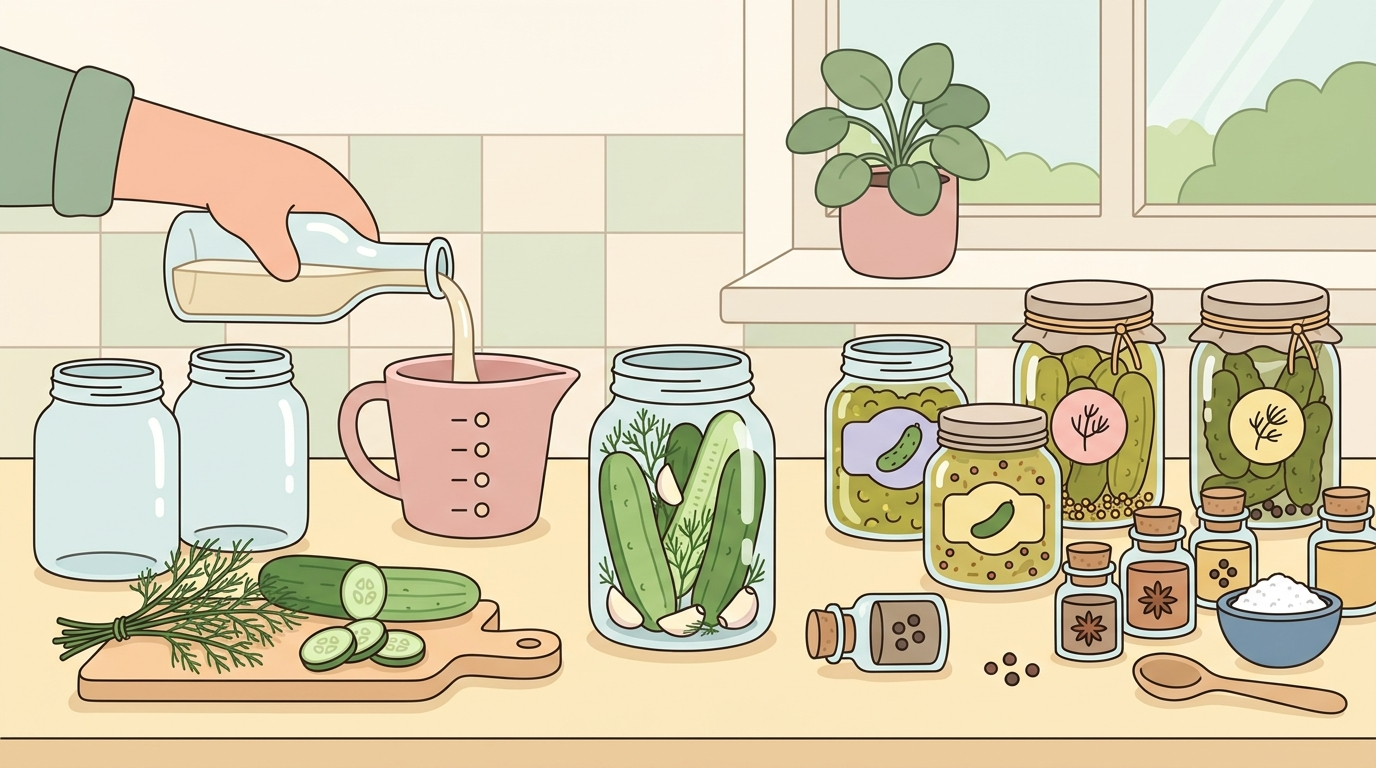
- Water-bath canner with rack (or a large stockpot with a folded towel on the bottom)
- Wide-mouth mason jars—pints for most pickles, half-pints for relish
- New lids (bands can be reused, lids cannot)
- Pickling salt, not table salt or kosher salt
- White distilled vinegar at 5% acidity, or apple cider vinegar labeled 5%
- A jar lifter—don’t skip this, tongs drop jars and hot water burns
- A wide-mouth canning funnel (about six dollars, worth every cent)
- A magnetic lid wand or small tongs for lids
- Grape leaves or oak leaves if you want to add tannins for crunch
- Your tested recipe printed out or propped open where you can see it without touching it with wet hands
- A timer you will actually set
The total equipment cost if you’re starting from nothing is around forty to sixty dollars. The canner itself is the biggest expense—a basic enamel water-bath canner with rack runs twenty to thirty dollars. After that it’s mostly jars, which you reuse for years.
TL;DR: Acid level and salt type are the two variables that cause most failures. Use pickling salt, use vinegar that’s labeled 5% acidity, follow a tested recipe for ratios, and soak your cucumbers in ice water before you pack them. Everything else is seasoning.
I’m still not sure whether my bread-and-butter pickle problem is the cucumber variety, the sugar source, or something in our well water that I haven’t accounted for. Ben thinks I’m overthinking it. He’s probably right. But I’m going to try one more batch this August with a different sugar and see what happens, because that’s how this goes—you figure out most of it and then there’s the one thing that just keeps being weird.