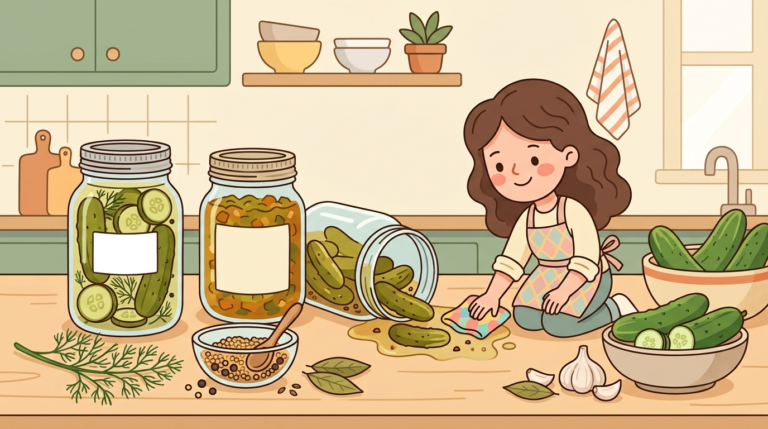
I Ruined 12 Jars Before Mastering These Pickle Recipes—Here’s What Actually Works
“You should just try the Ball Blue Book recipes,” Ben said, watching me dump twelve jars of cucumber mush into the compost bin. “Stop overthinking it.” He was right, but also completely unhelpful in that moment. Those jars had taken three pounds of cucumbers, a full afternoon, and whatever was left of my confidence in the kitchen. I’d gone looking for the best canning recipes for pickles and relish during our first summer here, found seventeen different versions of the same garlic dill, picked one that looked authoritative, and still ended up with soft, hollow spears floating in cloudy brine.
That was three years ago. I’ve made a lot of pickles since then. Some of them are actually good.
The Batch That Turned to Mush
The cucumbers were the problem, but I didn’t know that yet. I’d picked them on a Thursday, let them sit in a bowl on the counter until Saturday because life, and by the time they went into the jars they’d already started converting starches in a way that no amount of brine fixes after the fact. Twelve half-pint jars, all sealed perfectly, all disgusting.
What nobody told me in that first year: cucumbers for pickling need to go from the vine to the jar within twenty-four hours, ideally less. The blossom end has enzymes that cause softening, and those enzymes don’t stop working just because you left the cucumbers on your counter. You’re supposed to cut that end off. I didn’t know. The recipe didn’t say.
I also used the wrong cucumbers—big slicing varieties from the farmers market because I hadn’t grown my own yet. Pickling cucumbers, the stubby warty ones like Calypso or National Pickling, have thinner skins and drier flesh. They hold up. Slicers don’t. That’s not overthinking. That’s just a thing you have to know.
What Actually Goes Into a Canning Recipe
For a basic garlic dill pickle brine that won’t land you in trouble, you need these things in this order:
- Cucumbers. Use a pickling variety, harvested within 24 hours. Trim the blossom end. Soak in ice water for two hours before packing—this is what keeps them crisp.
- Vinegar. White distilled, 5% acidity. Not apple cider unless the recipe specifically calls for it and accounts for the lower acid. The National Center for Home Food Preservation is blunt about this: do not reduce vinegar, do not substitute lower-acid vinegars without a tested recipe.
- Salt. Canning or pickling salt only. Table salt clouds the brine. Kosher salt has variable grain sizes and you’ll measure it wrong.
- Brine ratio. For a standard dill pickle: 1 cup white vinegar, 1 cup water, 1 tablespoon pickling salt. Scale up from there. This is a 1:1 ratio and it’s safe.
- Garlic and dill. Pack fresh dill heads or two teaspoons dried dill seed per pint. One or two cloves fresh garlic per jar. More garlic does not equal better pickles—it just gets sharp and strange after processing.
- Processing time. Pints in a water bath canner for 10 minutes at altitudes below 1,000 feet. We’re in middle Tennessee, so that applies here. Check the USDA’s food safety guidelines if you’re at elevation.
- Rest time. Six weeks minimum before opening. I know. It’s hard. Open them too early and they taste like vinegar water with a vegetable suggestion.
Dill versus no dill (and why it matters more than you think)
The assumption is that dill pickles need dill. That seems obvious. But a lot of traditional Polish and Eastern European pickle recipes use no dill at all—just garlic, mustard seed, and sometimes horseradish root. The cucumbers taste sharper, more like the cucumber itself. Some people find them cleaner.
I don’t have a recommendation here. I just think it’s worth knowing that “dill pickle” is one specific style, not the only style, and that the dill can actually compete with the cucumber flavor in a way you might not want. Try a batch without it sometime. See what you think. The brine ratio stays the same either way.
The one recipe that works but shouldn’t
Every source I’ve read says cold-pack your cucumbers—raw into the jar, pour hot brine over them, process immediately. Hot-packing vegetables that are already fragile makes no sense. And yet the one pickle recipe that’s consistently given me the crunchiest results is a hot-pack bread and butter from an old church cookbook I found at an estate sale, where you actually cook the cucumber slices briefly in the brine before jarring.
It shouldn’t work. The cucumbers see heat twice—once in the brine, once in the water bath. By every principle I understand, they should be mush. They’re not. They come out with a specific firmness that cold-pack bread and butters never match for me. I have no explanation. I’ve made this batch six times. Same result every time.
The recipe uses more sugar than standard (three cups to four cups vinegar), which may affect the texture. Or the turmeric does something. Or it’s the short cook time—only four minutes. I genuinely don’t know, and I’ve stopped trying to figure it out.
- Slicing cucumbers instead of pickling varieties—always turns soft
- Letting cucumbers sit more than 24 hours before processing
- Skipping the blossom end trim
- Using apple cider vinegar without adjusting the recipe for lower acidity
- Opening jars before six weeks—tastes sharp and undeveloped
- Doubling the garlic because more seems better—it isn’t
About the relish recipes nobody wants to make
Old relish recipes are fussy. You salt the vegetables overnight, drain them, sometimes rinse them, cook them down, add vinegar and sugar in ratios that take actual math to scale, then process them in smaller jars because relish doesn’t keep once opened. The yield is low. The time investment is high. A case of pickles from the same cucumbers feels like more for your effort.
But here’s the contradiction I keep running into: the old relish recipes—the ones from the Ball Blue Book or from extension services—are tested. They’re reliable. The newer “simple” relish recipes floating around online often aren’t tested for pH safety and I don’t trust them. So the recipes I’d recommend most confidently are the ones I make least often, because they’re annoying to execute. That tension doesn’t resolve neatly. The NCHFP pickle and relish section has the tested versions if you want them.
Getting the vinegar ratio right (5 tries later)
Balance matters more than most beginner canning guides admit. Here’s what I track now:
- Too sharp: Usually means the water-to-vinegar ratio is off or you added too little sugar for a sweet pickle. Add a quarter teaspoon of sugar per pint and taste the brine before jarring.
- Too flat: Usually means old vinegar—yes, it goes stale—or not enough salt. Check your vinegar’s acidity on the label. It should say 5%.
- Cloudy brine: Almost always the salt. Switch to pickling salt. If you’ve already processed, it’s cosmetic, not a safety issue, but it looks bad.
- Weak garlic flavor: Fresh garlic, not jarred. Jarred garlic in brine just tastes sour and faint. Two full cloves per pint, sliced in half so they release.
- Bitter finish: This one took me the longest to diagnose. It was the spice blend I was using—pre-mixed pickling spice from a grocery store that had been on the shelf too long. Buy whole spices and mix your own, or at minimum buy from somewhere with high turnover.
- A basic water bath canner kit runs about $30–$40 at Tractor Supply or online—worth buying the set with the jar lifter and rack
- Wide-mouth pint jars are easier to pack than regular-mouth for whole spears
- A jar funnel costs two dollars and saves a lot of mess
- A digital kitchen scale is more accurate than volume for salt—aim for 1% to 2% salt by weight in your brine
Why some jars still seal and others don’t
I’ve done everything right—or what I think is right—and still had one jar in a batch refuse to seal. Same lids, same processing time, same headspace. The others ping within ten minutes of coming out of the canner. That one sits on the counter silent until I give up and put it in the fridge.
I’ve checked the rim. No chips. Wiped it clean before lidding. Proper headspace. Ben thinks it’s the lids, that there’s occasional variance in the sealing compound. Maybe. I’ve also wondered if the jar itself has a micro-flaw I can’t see. I don’t have an answer. It happens maybe once every two batches, which isn’t a crisis, but it’s also not explained by anything I’ve found in the extension service guidance.
The recipes I actually use (not the ones I recommend)
If someone asks me for a reliable starting point, I send them to the Ball Blue Book or the NCHFP site. Tested recipes, proper ratios, no guessing on safety. That’s the honest answer for someone new to this.
What I actually make most often is a half-sour refrigerator pickle that never sees a canner at all—just brine, herbs, a week in the fridge. It’s not shelf-stable. You can’t give it as a gift or count it as part of any serious pantry storage plan. But it tastes better than anything I’ve put in a jar and processed, and it takes forty minutes start to finish including cleanup.
The pickles and relish recipes I’d call my best are the ones I’ve made enough times to know what they look like when they go wrong. That takes a few batches. Probably a few failed ones. The ratio of bad jars to good has shifted over three years, but it hasn’t hit zero, and I’m not sure it ever will. Start with one tested recipe, make it twice before you change anything, and keep notes on what the brine tasted like before you lidded it. That’s the thing that’s actually helped more than any recipe.