Best Canning Recipes for Pickles and Relish: What I Learned After My First Batch Failed
I was pulling cucumber beetles off the vines when I decided I needed to actually figure out canning this year, not just wing it like the summer before. I’d been reading about the best canning recipes for pickles and relish for weeks, bookmarking things, starting a new page in my garden journal, then abandoning it when June got into the herb spiral again. But the cucumbers weren’t going to wait, and I’d already lost one summer’s worth of produce to bad technique and worse decisions.
What I’m writing here is mostly what I had to figure out the hard way, plus some things I’ve since confirmed with the National Center for Home Food Preservation, which is the only canning resource that I trust completely on food safety. If you’re brand new to this, go read their guidelines first. Then come back here for the parts they assume you already understand.
The 5 things your recipe needs before you start
Not equipment in general. Specific things that will ruin your batch if you skip them.
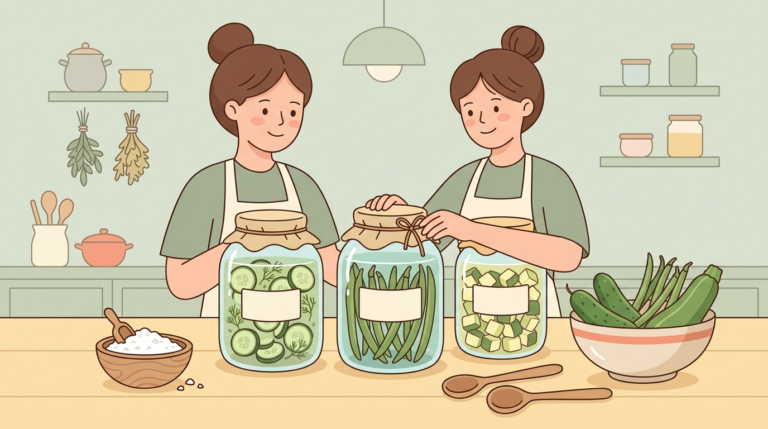
- Pickling cucumbers, not slicing cucumbers. Kirby cucumbers or any variety labeled “pickling” have thinner skins and fewer seeds. Slicers turn to mush in the brine. This is the single most common beginner mistake and no recipe I read that first year mentioned it with any urgency. National Pickling, Boston Pickling, Calypso — any of those work. Grow your own if you can; cucumber varieties at most hardware stores are almost all slicers.
- Canning salt, not table salt. Table salt has anti-caking agents. They cloud your brine and can affect texture over time. A five-pound bag of pickling salt runs about four dollars at Tractor Supply and lasts a long time. It’s not a luxury swap.
- A jar lifter and a wide-mouth funnel. You can improvise a lot of things in canning. Pulling hot jars out of boiling water with tongs is not one of them. The metal gripper jar lifter with rubber coating costs around eight dollars and is non-negotiable.
- New lids, every time. Rings can be reused if they’re not rusted or bent. Lids cannot. The sealing compound degrades. Don’t reuse lids from jars you bought at the store either.
- A proper water bath canner or a stockpot deep enough to cover your jars by at least an inch of water. The rack at the bottom matters — without it, jars sit directly on heat and can crack. A canning rack costs about six dollars. If you’re going to do this more than once, the Ball enamel canning kit runs around thirty dollars and includes the rack, jar lifter, funnel, and lid wand. Worth it if you’re starting from zero.
About the dill question
Every recipe has an opinion. Fresh dill heads, dried dill seed, dill weed — and I’ve used all three at different points, sometimes because I planned it that way and sometimes because the dill in my herb spiral bolted too early or the dried stuff ran out mid-batch. What I’ve noticed: fresh dill heads give a stronger, more herbal flavor in the first month. Dried dill seed gives a slightly sharper, more uniform flavor that holds up better in jars you open four months later. Dill weed (the feathery part, dried) is the mildest and, honestly, the least interesting of the three. But I’m not prepared to say one is definitively better. It might just depend on your cucumbers.
How to keep pickles crisp instead of mushy
Processing time is the first place to look. Over-processing kills crispness. For quart jars of whole dill pickles, the NCHFP recommends 15 minutes in a boiling water bath at altitudes below 1,000 feet — and we’re well below that in Tennessee. Don’t go longer trying to be safe. Longer processing doesn’t make them safer; the acidity does that. Longer processing just makes them soft.
Cucumber selection matters as much as technique. Pick cucumbers when they’re small to medium — four to five inches for spears, two to three inches for whole pickles. Larger cucumbers have more developed seeds and more water in the flesh, and that water works against you. Pick in the morning before the heat of the day, and get them into brine within twenty-four hours. Cucumbers sitting on your counter lose moisture and firmness fast, especially in a Tennessee August.
Calcium chloride — sold as Pickle Crisp — actually works. You add about a quarter teaspoon per quart jar directly before sealing. It’s a mineral salt that firms cell walls. I was skeptical because it sounds like a chemistry project, but the difference in texture is noticeable. Find it in the canning section at most grocery stores in late summer or order it online. A small jar is around five dollars and does a lot of batches.
The old-fashioned alternative is a grape leaf or an oak leaf in each jar. Both contain tannins that do roughly the same thing. I have a Concord grape vine along the back fence, so I’ve used leaves from there with decent results. It’s less consistent than calcium chloride but it works, especially if you’re already growing grapes.
One more thing: blossom end removal. The blossom end of a cucumber — the end opposite the stem — contains enzymes that soften pickles. Slice off a thin sliver of that end before packing. It takes thirty extra seconds and makes a real difference.
Why stronger vinegar actually changes everything (and what I thought before)
I spent my first canning season assuming vinegar was vinegar. The recipe said vinegar, I used whatever was in the cabinet. Sometimes that was apple cider vinegar at 5% acidity. Sometimes it was a store brand white vinegar that I now realize I never checked the label on.
Here’s the problem: home canning safety in water bath canning depends entirely on acidity. The USDA and the NCHFP both base their tested recipes on 5% acidity vinegar. If your vinegar is weaker — and some store brands come in at 4% — the pH of your finished product may not be low enough to prevent bacterial growth. That’s not a texture issue. That’s a food safety issue.
Always check the label. It should say “5% acidity” or “50 grain.” Most major brands of white distilled vinegar are 5%, but it’s worth confirming every time. Apple cider vinegar at 5% is fine and will mellow the flavor slightly. Do not use homemade vinegar for canning — the acidity is not consistent enough to test safely.
I used to think the vinegar type was mostly a flavor choice. It’s not. The percentage is a safety requirement, and the type is a flavor choice within that constraint.
I used a grape leaf in each jar because the Concord vine was right there, and it actually worked, which annoyed me because I’d already bought the Pickle Crisp.
The relish that shouldn’t have worked
Last August I made a batch of cucumber relish on a day when I was already behind on bookkeeping and Pepper had gotten through the garden fence into the bean row. I was moving fast and I forgot the celery seed entirely. Celery seed is in basically every relish recipe I’ve seen — it’s almost definitional to the flavor. I didn’t realize I’d skipped it until the jars were already sealed and cooling on the counter.
I opened a jar three weeks later expecting something flat and wrong. It tasted fine. Better than fine, actually — cleaner and brighter than my previous batches, which Ben had described as “kind of medicinal.” He wasn’t wrong. I’d been heavy-handed with the celery seed before.
I can’t fully explain it. The mustard seed and turmeric were both in there, the vinegar ratio was right, the cucumbers were good. Maybe the celery seed had been overpowering other flavors all along. Maybe that particular batch of cucumbers was just better. I’ve made relish twice since then intentionally leaving out the celery seed, and neither batch was as good. So I don’t know what happened with that jar and I’ve stopped trying to figure it out.
My first summer canning disaster and what it cost me
Our first year here, I grew more cucumbers than I knew what to do with. Good problem to have, theoretically. I had a vague plan to can them. I’d watched a few videos, read half of one recipe, and figured the general idea was enough.
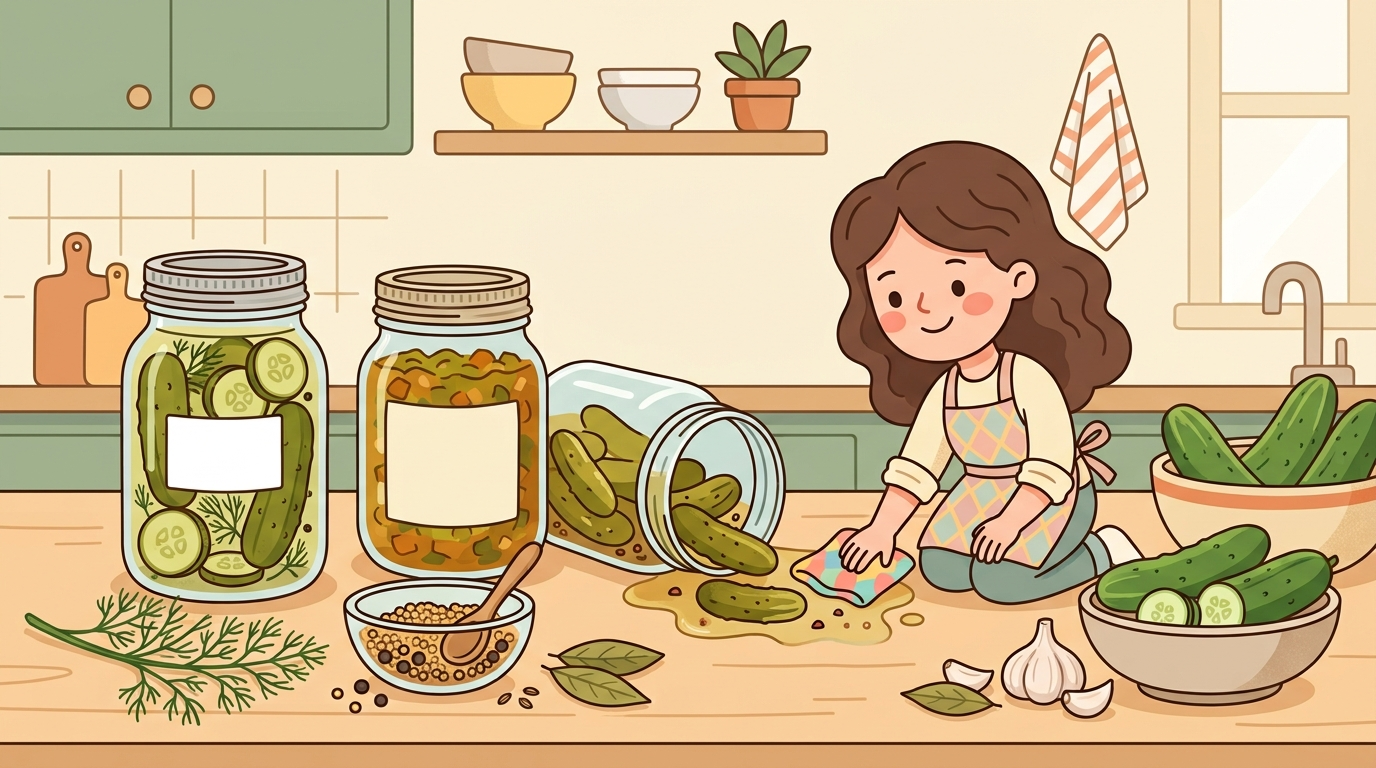
I used slicing cucumbers from the garden because I didn’t know there was a difference. I used table salt. I didn’t remove the blossom ends. I processed the jars for twenty minutes because I thought longer meant safer. The brine went cloudy within two weeks, and when I opened a jar at the end of September, the pickles were the texture of wet paper. Soft all the way through, not just at the edges. Inedible.
I’d grown maybe forty pounds of cucumbers that summer. I salvaged a small amount for fresh eating. The rest went to the compost. That’s not a lesson I needed to learn twice, but there’s no quick fix that would have saved that batch once the processing was done wrong. The damage was already in the jars.
What it actually cost: about a full day of picking, washing, and canning, plus twelve lids, the salt, the vinegar, and the cucumbers themselves. The whole batch was probably fifteen dollars in inputs and six hours. Not catastrophic. But it was demoralizing enough that I almost didn’t try again the following summer. Ben talked me into it, which I’m not going to admit to him because he’ll bring it up forever.
- Use only pickling cucumber varieties, picked small
- Confirm your vinegar is 5% acidity — check the label every time
- Remove a thin slice from the blossom end of each cucumber
- Add calcium chloride or a grape leaf for crispness
- Process for the correct time only — not longer
- Let jars cool undisturbed for 12-24 hours before moving them
What recipe writers assume you already know
Most canning recipes are written for people who have already canned before. Here’s what gets left out consistently.
- Headspace is not approximate. Quarter-inch headspace for pickles means a quarter inch, measured from the top of the liquid to the rim. Too little and the lid may not seal because liquid gets forced out during processing. Too much and you may get a false seal that fails later. A wide-mouth canning funnel makes this much easier to judge.
- Jar temperature matters. Cold jars going into hot water can crack. Warm jars into simmering water are fine. Keep your jars in warm water until you’re ready to fill them, or run them through a dishwasher cycle without drying.
- Don’t move the jars while they’re cooling. That popping sound as jars seal is the lid flexing down. Let them sit flat and undisturbed on a towel for twelve to twenty-four hours. Moving them can break the seal before it sets.
- Check the seal before you store. Press the center of each lid. If it flexes up and down, it didn’t seal. Refrigerate and use within a week, or reprocess within twenty-four hours with a new lid.
- Brine gets absorbed as pickles sit. Open a jar the day after you make it and the cucumbers will taste mostly like vinegar water. Wait two to four weeks minimum. The flavor develops as brine moves into the cucumber. For relish, a week is usually enough.
- Your altitude affects processing time. Most recipes are written for below 1,000 feet. Tennessee varies, but most of us are well under that. If you’re somewhere higher, the NCHFP altitude adjustment charts are the reference to use — not guesswork.
The one thing I’d tell someone starting out: use a tested recipe from NCHFP or the Ball Blue Book the first two or three times. Don’t improvise on ratios, especially the vinegar-to-water ratio. Once you understand why each piece is there, you can adjust the spices and flavors all you want. The acid ratio is not the place to experiment.