Why My First Batch of Pickles Failed (And What I Do Now)
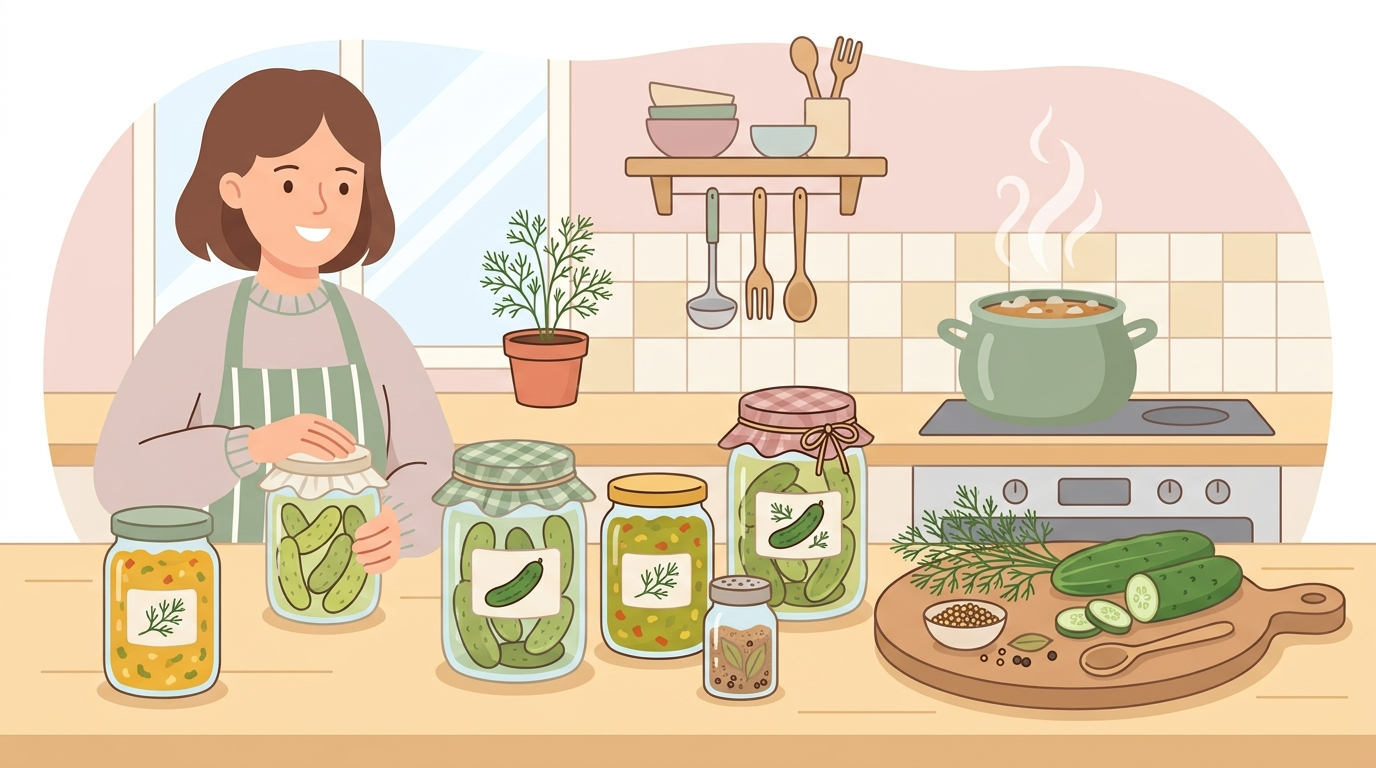
The smell of hot vinegar brine is one of those things that gets into the walls of an old farmhouse and stays there. I noticed it again last week while I was pulling jars from the water bath canner, and it reminded me how long it took me to stop losing batches. Three years in, I’ve worked through most of the best canning recipes for pickles and relish I could find — tested recipes from the National Center for Home Food Preservation, old church cookbooks, extension service bulletins — and the gap between a recipe that looks right and one that actually works in your kitchen is still something I’m sorting out.
This is not a post about how I figured it all out. Some of it I have. Some of it I haven’t. That distinction matters if you’re about to spend a Saturday afternoon and twenty pounds of cucumbers on this.
What your recipe isn’t telling you
Most tested canning recipes will tell you headspace, processing time, and vinegar ratio. What they don’t tell you is that headspace varies by jar shape, that processing time assumes you started with hot jars and hot brine simultaneously, and that “bring to a boil” means a full rolling boil — not the thing that looks almost like a boil but settles down when you stir it.
The cooling step is another one. Recipes say remove jars and let cool undisturbed for 12 to 24 hours. What they don’t say is that moving jars before they’re completely cool — even just sliding them an inch on the counter — can cause a false seal. The lid pops down, looks sealed, and then fails in the pantry three weeks later. This happened to me with a whole batch of bread and butter pickles in my second summer. Seven jars. All false seals. The lids pinged when I pressed them and that was that.
Pot temperature before you lower the jars in matters more than most recipes admit. Your water bath canner should be hot — around 180°F — when you put the filled jars in, not cold, not boiling. Cold water on a hot jar cracks it. Boiling water before the jars are in means you’ve already been boiling for nothing and your processing time is off. A cheap candy thermometer clipped to the side of the pot costs about eight dollars and removes a lot of guessing.
The equipment question nobody answers directly
I’ve used a 21-quart Granite Ware water bath canner, a large stockpot with a folded dish towel on the bottom instead of a rack, and a smaller 12-quart pot when I was only doing a few jars. I got different results every time, and I cannot tell you with certainty which variable was responsible.
The jar type matters — wide-mouth versus regular-mouth seals differently, and I’ve had better luck with wide-mouth Ball Mason jars for anything chunky. But some people swear by Kerr. Some people do fine with off-brand lids. Others get consistent failures. Whether it’s the lid composition, the rim tolerance, the batch of lids, or something in their water — I genuinely don’t know. Electric stoves run hotter or uneven depending on the burner. Glass-top stoves have their own issues with heavy canners. I’m on a gas range, which is more stable, but even that varies.
Nobody in any canning guide I’ve read will just say: your results will vary based on equipment in ways we can’t fully predict. That’s the honest answer. The National Center for Home Food Preservation gives tested procedures, and those procedures are your best starting point — but they were tested in controlled conditions, not in your drafty farmhouse kitchen in July with a canner that’s slightly too small for a full batch of quarts.
How to actually use a tested canning recipe for pickles and relish
This is the part where I’m going to be specific, because most instructions skim over the actual sequence.
- Start with a tested recipe only. The NCHFP website has free tested recipes for dill pickles, bread and butter pickles, and several relishes. The vinegar-to-water ratio in those recipes is not decorative — it determines whether the pH is safe. Don’t adjust it.
- Wash and inspect your jars the night before. Look for chips on the rim. A chipped rim won’t seal. Run your finger around every rim. Discard anything questionable.
- Use new lids every time. Bands can be reused if they’re rust-free. Flat lids cannot. The sealing compound degrades. A box of a dozen lids runs about two dollars at Tractor Supply — this is not the place to economize.
- Start heating your canner before you start packing jars. Fill it with water, put it on the heat. You want it around 180°F when your filled jars go in.
- Heat your brine to a full rolling boil before pouring. A rolling boil means it keeps boiling even when you stir it. This matters for both safety and for getting the jars to temperature evenly.
- Pack jars, leave correct headspace, wipe rims with a damp cloth. Brine residue on the rim prevents sealing. Use a clean cloth, not a sponge. Headspace for pickles is typically 1/4 inch — measure it with a headspace tool or a ruler the first few times.
- Lower jars into hot water gently. A jar lifter costs about six dollars and is the only way to do this without burning yourself. The water should cover jars by at least one inch. If it doesn’t, add boiling water from a kettle — not cold tap water.
- Start your processing timer only when the water returns to a full boil. Not when you put the jars in. When the water is back at a full rolling boil. For most pickle recipes in half-pints or pints, processing is 10 to 15 minutes. For quarts, it’s longer — check your specific recipe.
- Remove jars and set on a folded towel, not directly on a cold counter. Cold surfaces cause thermal shock. Leave at least an inch between jars. Don’t cover them. Don’t move them. Wait 12 to 24 hours before checking seals.
- Check seals by pressing the center of each lid. A sealed lid is concave and doesn’t flex. If it pops up and down, it didn’t seal. Refrigerate those and use them within a few weeks.
- Tested recipe from NCHFP or your state extension service
- New flat lids
- Candy or instant-read thermometer
- Jar lifter
- Headspace measuring tool
- Canner large enough that jars are covered by at least one inch of water
The vinegar thing that worked but shouldn’t have
In my first summer I made a batch of garlic dill pickles with white vinegar that was labeled 4% acidity instead of the standard 5%. The recipe called for 5%. I didn’t notice until the jars were already packed and in the canner.
All twelve jars sealed. I checked them after two weeks in the pantry, popped one open, tasted fine, no mold. Gave some to a neighbor. Nobody got sick. I repeated the same mistake the following month with the same results.
I’m not telling you to do this. The USDA and every extension resource I’ve read say 5% acidity minimum for water bath canned pickles, and the safety margin built into tested recipes is not arbitrary. But I also don’t know why my off-ratio batches sealed and kept without spoiling, and I’m not going to pretend otherwise. It happened, I didn’t understand it, and I switched back to 5% vinegar and stopped wondering about it.
Twelve jars sealed just fine on the wrong vinegar, and I’ve never been able to explain it, and it bothers me more now than it did then.
Why I still mess this up sometimes
Last August I made a double batch of sweet relish — cucumbers, onions, bell peppers, the whole thing — and lost eight of fourteen jars. Not to failed seals. To soft texture inside sealed jars, which is a different and more demoralizing problem.
I had skipped the salting step. The recipe says to salt the vegetables and let them sit for two hours, then rinse. I did thirty minutes because I was also trying to deal with Pepper, who had gotten through the garden fence again and was making her way toward the herb spiral. I pulled her out, fixed the fence temporarily with a piece of baling wire, went back inside, and told myself thirty minutes was probably enough.
It wasn’t. The jars sealed fine. The relish was mushy. You can’t un-mush relish. I’ve read since that the salting step draws moisture out of the vegetable cells and helps them hold texture through processing, but I don’t fully understand the mechanics of why thirty minutes versus two hours made such a visible difference. I just know it did. Ben thought I was being too hard on myself about it. I’m still annoyed.
I don’t have a fix for this beyond not skipping steps. That’s not a satisfying answer, but it’s the real one.
The relish recipes that actually have better odds
After several batches of various things, these are the patterns I’ve noticed in what tends to work more reliably:
- Cooked relishes over raw-pack. Recipes where the vegetables are cooked in the brine before packing tend to give more consistent seals than raw-pack methods. The jars go in hot, the fill is hot, everything is already at temperature when it hits the canner.
- Smaller jars. Half-pints seal more reliably than quarts for relish, probably because they reach processing temperature faster and more evenly. They also get used up faster once opened, which reduces the chance of spoilage after opening.
- Higher sugar content. Sweet relishes seem to give me fewer mold failures after opening than low-sugar or vinegar-forward versions. Not sure if this is the sugar acting as a preservative or just coincidence across my small sample size.
- Corn relish and green tomato relish. Both of these have given me better results than cucumber relish consistently. Corn relish in particular has never given me a texture problem, probably because cooked corn doesn’t have the same moisture release issue.
- Standard cucumber dill pickle spears over chips or slices. Spears hold texture better through processing. Chips go soft at the edges. Slices are somewhere in the middle.
TL;DR: Follow a tested recipe exactly, start with hot jars and hot brine, don’t move jars until fully cool, use new lids every time, and measure your headspace. Relishes in half-pints with cooked fills fail less often than raw-pack pickles in quarts. The vinegar ratio in your recipe is not adjustable.
Are the recipes worth the risk
I’ve been thinking about this more honestly lately. Cucumbers from our garden cost us basically the price of seeds and water, so the ingredient cost is genuinely low. But when I add up the lids, the vinegar, the sugar and spices, the propane for the canner running for an hour, and my time — a full canning afternoon is probably four to five hours when you count prep and cleanup — it’s not obviously cheaper than buying pickles at the store.
What I can’t figure out is whether homemade is actually safer or just feels safer because I made it. I know what went into the jar. I also know I skipped a step once, used the wrong vinegar ratio twice, and still can’t fully explain my seal failure rate. Commercial pickles are made under conditions I can’t replicate and are tested in ways I’m not equipped to do. The NCHFP guidance exists because people got seriously ill from improperly home-canned food, and that’s not ancient history.
Shelf life is another open question. I’ve read twelve to eighteen months for best quality in home-canned pickles, but I’ve eaten jars at twenty months that tasted fine, and I’ve opened jars at eight months that were off. I don’t know if that’s the recipe, the seal quality, or the pantry temperature in an old farmhouse that gets warm in summer because we don’t have central air in that part of the house.
I keep doing it. The rows of jars on the pantry shelf feel worth something that I can’t entirely justify with math. But I’m less certain than I used to be that I have this figured out.