How We Stopped Buying Pickles—Preserving Food With Salt the Old Way
“You know you can just—put salt on it, right?” Ben said this over his shoulder while I was on my phone trying to figure out why our cucumber ferment smelled like a gym locker. He didn’t look up from whatever he was reading. “Like, that’s the whole thing.”
I did not find that helpful at the time. But he wasn’t wrong, and that’s kind of the whole story of how we ended up preserving food with salt at home using methods I’d been too intimidated to try for two full years. We moved out here to this drafty farmhouse in rural Tennessee three years ago, and I spent most of year one buying jarred pickles at the grocery store like I wasn’t sitting on half an acre of cucumbers. Something had to give.
What You Need (Spoiler: Just Salt)
I overresearched this for weeks before I did anything. You don’t need to. Here’s what actually matters:
- Salt: Non-iodized. Iodine interferes with fermentation. Pickling salt or kosher salt (Diamond Crystal or Morton, either works—but they measure differently by volume, so weigh it if you’re being precise). A kitchen scale costs about $10 and you will use it constantly. Canning salt is the same as pickling salt.
- Vessels: Wide-mouth mason jars. Quart size for most vegetables. Half-gallon if you’re doing big batches. I use Ball brand because that’s what Tractor Supply carries, but generics work fine for ferments.
- Something to keep vegetables submerged: A small zip-lock bag filled with brine works. So does a clean rock. I’ve used a folded cabbage leaf weighted down by a jar lid. None of these are elegant.
- A kitchen scale: For brine ratios. You can do it by volume but weight is more consistent.
- Cool, dark storage: This is where it gets complicated, which I’ll get to later.
That’s it. No canning kettle, no pressure canner, no special equipment. If you want airlocks for your jars, they run about $8 for a pack of four on Amazon and they do make things less fussy—but I fermented a dozen batches without them before I bought any.
How to Make Salt-Preserved Vegetables at Home
This is for basic lacto-fermented vegetables, which is different from dry-salted curing (like making salt pork or gravlax). Both use salt. This method uses a brine.
- Make your brine. A 2% brine is where I start for most vegetables—that’s 20 grams of non-iodized salt per liter of water. For a crunchier, more aggressively sour result, go up to 3%. Dissolve salt in room-temperature water and stir until clear.
- Prep your vegetables. Wash them. Don’t scrub aggressively—you want the natural bacteria on the skin. Slice cucumbers into spears or coins. Leave garlic cloves whole. Green beans can go in whole.
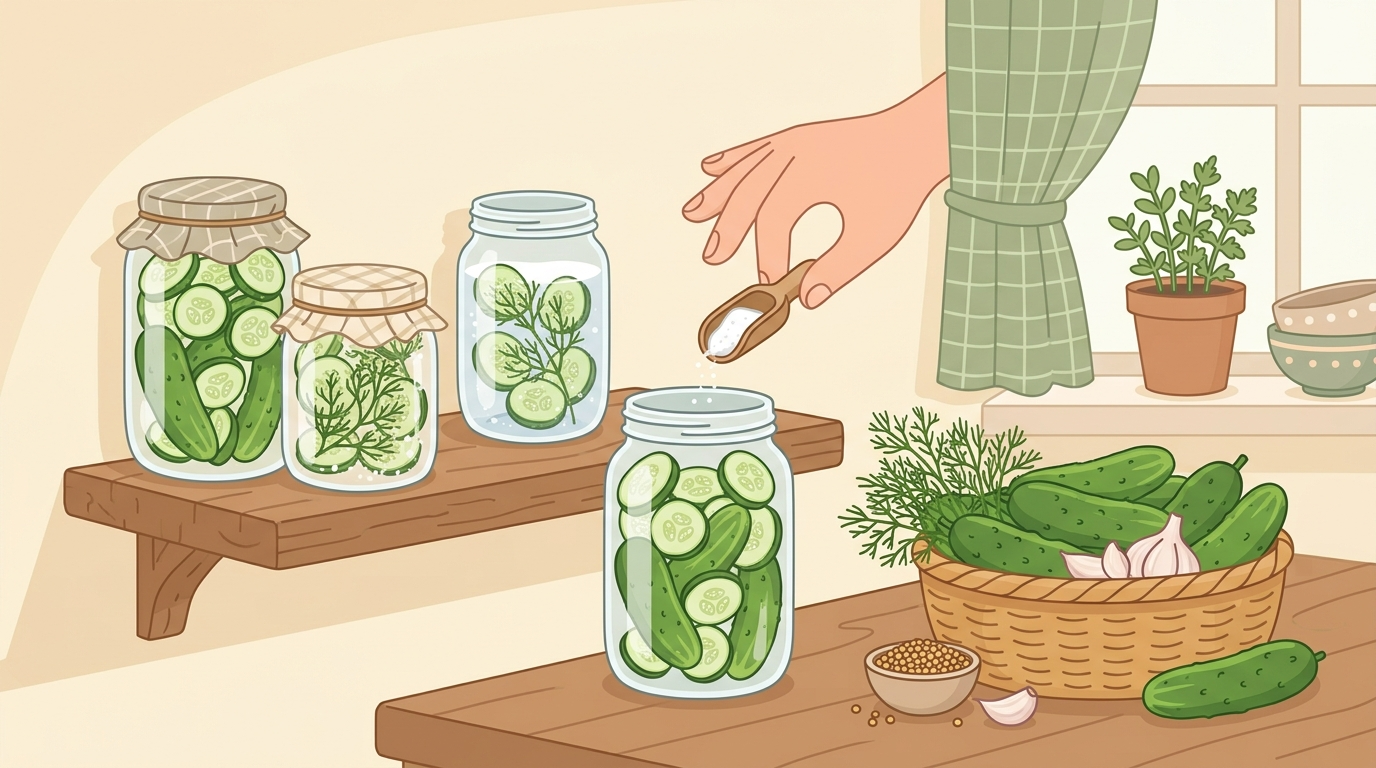
- Pack your jar tightly. Add any aromatics—dill, garlic, peppercorns, a dried chili. Pack the vegetables in so they don’t float easily.
- Pour brine over vegetables until they’re covered. Leave about an inch of headspace.
- Weigh the vegetables down so nothing is above the brine line. Exposed vegetables get moldy. This step matters.
- Cover loosely. A cloth secured with a rubber band, or a lid set on top without being screwed down. Gas needs to escape. If you seal it completely, pressure builds and things get messy.
- Ferment at room temperature for 3 to 7 days. In Tennessee summer heat, fermentation moves fast—sometimes too fast. In a 75-degree kitchen, three days might be plenty. Taste daily after day two.
- When they taste right, seal the jar and move to cold storage. The cold slows fermentation significantly. They’ll continue to change, just slowly.
The National Center for Home Food Preservation has guidance on vegetable fermentation and salt-cured products if you want to go deeper on ratios and safety specifics. I refer back to it more than I expected to.
Why We Actually Started This
It wasn’t about saving money, even though we do spend less now. It started at the farmers market—Ben had volunteered us to have a table, naturally, without asking me—and someone at the booth next to us was selling fermented pickles for $9 a jar. I stood there for a minute thinking about the cucumbers rotting in our kitchen. We had too many. We always have too many. That’s just summer in Zone 7a in Tennessee.
I’d been scared off fermentation by a very alarming forum post I’d read about botulism. Spent three weeks researching before I touched a vegetable. What I eventually learned is that vegetable ferments—the lacto-fermented kind done with brine at room temperature—are actually quite different from canning in terms of safety risk. The acidic environment created by fermentation is actively hostile to botulinum toxin development. The USDA and most extension services draw a clear line between pressure-canned low-acid foods (higher risk) and lacto-fermented vegetables (different risk profile). I’m not a food safety professional and you should read the actual guidance rather than taking my word for it, but understanding that distinction finally got me started.
Ben’s take, for what it’s worth: “You’re going to eat it in two weeks, relax.” He’s been right about things like this before, which is annoying.
My ferment log from August just says “too fast, too hot, smells like a pickle left in a car” and then nothing for three days and then “actually fine.”
About the Shelf Life Question
I assumed, going in, that making my own would mean longer shelf life. Less processing, more natural, should last longer. That’s not really how it works.
Commercial pickles—the shelf-stable jarred kind—have been heat-processed to stop fermentation and kill off most microbial activity. They sit in your pantry for two years without much changing. A lacto-fermented jar in your refrigerator is alive. Fermentation slows in the cold but doesn’t stop. Most sources I trust suggest consuming refrigerator ferments within one to three months for best quality, though they’re often still safe longer than that.
So in some cases, my homemade fermented pickles have a shorter useful window than the $3 jar from the store. I hadn’t expected that. Ben pointed out that this wasn’t really a problem since we eat them fast enough, but for anyone hoping to stock a cold pantry through winter on salt ferments alone—it’s worth knowing the math doesn’t always work in your favor the way you’d expect. The NCHFP has specifics on storage recommendations if you want actual numbers rather than my rough estimates.
When Salt Curing Fails (And Nobody Tells You Why)
Three batches went straight into the compost. Not “eh, could be better”—genuinely bad, throw it out failures.
The first: I used table salt. I didn’t have pickling salt and figured salt was salt. It’s not. Iodine inhibits the bacterial activity you’re trying to encourage, and anti-caking agents cloud the brine and apparently affect texture. The cucumbers went soft and tasted metallic. Threw them out on day five.
The second was a brine ratio problem. I eyeballed the salt instead of weighing it, thought I had a 2% brine, probably had a 1% brine. Too little salt means the wrong bacteria win. The jar started smelling actively wrong—not sour-and-bright wrong but something-is-rotting wrong. There’s a difference and you learn it fast. That batch went into the yard.
The third failure I still don’t fully understand. I did everything right, by my standards. The cucumbers floated somehow—I thought they were weighed down but something shifted. The exposed ones got a white film on the surface that spread into the brine. I read enough to know that some white surface film (kahm yeast) is common and harmless. I also read that it isn’t always. I couldn’t tell the difference confidently enough to eat it. Threw it out.
There was no lesson I extracted from that third one. Sometimes things fail and you don’t get a clean explanation.
Does the Taste Actually Change Month to Month?
Yes. I can’t predict it or control it reliably, and I’m not sure anyone really can at the home scale.
A batch I made in late June tasted bright and sharp after four days—good, actually, better than I expected. The same batch a month later, still in the fridge, tasted more mellow and noticeably softer. Not bad, just different. A batch from August was more aggressively sour within days because our kitchen was hotter and fermentation moved faster. I tried to replicate the June batch in September and it tasted different—maybe the cucumbers were older in the season, maybe the ambient temperature shift mattered, maybe I had more garlic in there. I have no idea.
Ben thinks this is fine and that variation is part of it. I find it harder to accept because I kept a garden journal specifically to track this, and the journal is mostly just records of batches tasting slightly different from the previous ones with no pattern I can find. Tennessee’s swing from summer heat to cool fall happens fast enough that fermentation timing shifts a lot between July and October without me doing anything differently.
I don’t have a solution here. I’m documenting it because most articles I read made it sound more consistent than it is.
The Storage Problem I Still Haven’t Solved
Our pantry is off the back of the kitchen—an addition that Ben insists has “character” and I insist is uninsulated. In summer it runs warm. In winter it drops to somewhere in the 50s on cold nights, which is fine for some things and maybe too cold for others. We don’t have a dedicated root cellar, and the refrigerator only holds so much.
The temperature instability means my ferments behave unpredictably depending on where in the pantry I put them, what time of year it is, and whether we’ve had a cold snap. I’ve read about people using dedicated fermentation crocks with water-seal lids and that might help, but a good fermentation crock runs $40 to $100 and I haven’t committed to buying one yet. I’ve also looked at using a small dedicated mini-fridge as a fermentation chamber set to around 65 degrees, which would give more consistency. Haven’t done that either.
Ben suggested we just put them in the regular fridge from the start and skip room-temperature fermentation entirely. He read something on a homesteading forum about cold fermentation being slower but more controllable. I told him that seemed like giving up. He said that wasn’t what he said. We didn’t resolve this.
The honest thing to say is that three years into keeping a garden and trying to put food up, I’m better at growing cucumbers than I am at preserving them. The salt part turned out to be simple. Everything around the salt part is still a work in progress—and I said earlier that homemade methods give you more control than buying jars from the store. I’m not sure that’s true. You get more involvement. That’s not exactly the same thing.