I Stopped Fighting My Small Space—Here’s My Vegetable Garden Ideas for Small Spaces Layout Now
Ben looked at our half-acre kitchen garden last spring and said, “You know most people with a regular backyard could never do this, right?” He wasn’t being smug. He was pointing out that I’d spent a full year complaining about not having enough room when I had more growing space than most people ever see. The problem wasn’t square footage. It was that I kept treating the ground like it was the only place plants could go. Once I started thinking through different vegetable garden ideas for small spaces layout—vertical layers, perimeter use, spiral planting—the whole approach changed.
If you’re working with a genuinely tight yard, or even just a few raised beds, the single most useful thing I can tell you is this: stop planning on paper and look at your walls, fences, and anything taller than your knees. That’s where the extra room is.
Vertical first, ground second
Most small-space garden guides tell you to maximize your footprint. I’d argue you should barely think about the footprint until you’ve accounted for every vertical surface you own.
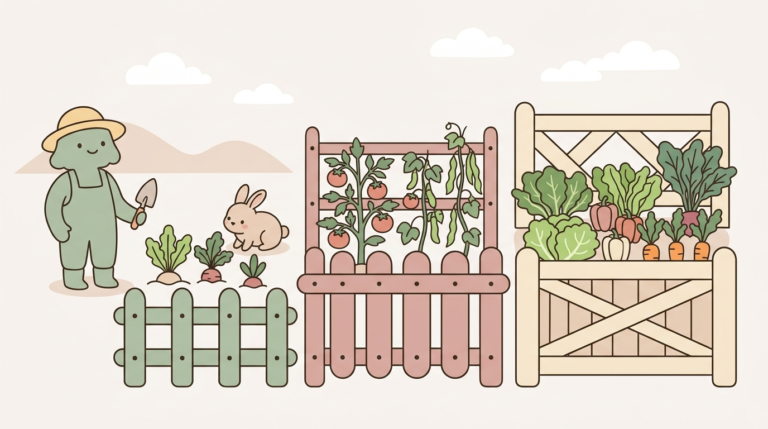
A six-foot cattle panel trellis—Tractor Supply sells them for around $25 each—gives you roughly 16 square feet of growing surface without using any ground space at all. Cucumbers, pole beans, small-fruited squash, and indeterminate tomatoes all climb. Plant them against a fence, a wall, or a freestanding panel and you’ve essentially doubled your usable space before you’ve put a single seed in the ground.
The priority order I use now: trellises and vertical structures first, then containers at varying heights, then ground-level beds. Ground beds get whatever’s left—root vegetables, sprawling herbs, things that genuinely don’t climb. It feels backward until you try it. After the first season of doing it this way, my output went up noticeably without expanding the footprint by a single inch.
For structures, wall-mounted planter pockets work well for lettuces and shallow-rooted herbs. Tower planters designed for strawberries work equally well for compact greens. A-frame trellises planted on both sides double your climbing space in a narrow strip. None of this requires Ben-level carpentry—though he did build me a cedar A-frame one Saturday that I have to admit works better than the hardware store version I bought first.
Why I kept measuring the same corner
Before I sorted any of this out, I spent probably three weeks measuring the same shady corner of the garden over and over. I had it in my head that if I just found the right configuration, the space would suddenly become enough. So I’d measure, sketch something in my garden journal, decide it wouldn’t work, and measure again.
Ben eventually walked by while I was crouched in that corner with a tape measure for the fourth time and said, “Is the corner getting bigger?” It wasn’t. Planning without planting is just a way of feeling productive without risking failure. At some point you put something in the ground and see what happens.
4 layout templates that actually fit tight yards
These aren’t magic. They’re just frameworks that tend to use awkward spaces better than a standard row layout does.
- L-shaped layout: Run beds along two adjacent fence lines and leave the interior open. This works well if you have a corner yard or a walled garden space. The L lets you access plants from the open side without stepping into the beds, and the corner junction is a natural spot for a trellis or tall focal plant. Good for yards that are more deep than wide.
- Spiral layout: A raised spiral bed, highest in the center, creates microclimates within a small footprint—drier and warmer at the top, cooler and moister at the base. My herb spiral runs about six feet in diameter and fits more variety than two of my standard raised beds combined. Thyme and rosemary go at the top. Mint and parsley at the bottom. University of Georgia Extension has solid information on companion planting that pairs well with this layout.
- Tiered layout: Stack beds at different heights—ground level, a raised bed, a container on a stand. You’re creating layers rather than rows. This works especially well on slopes, which most people treat as a problem. I have a slight grade on one side of the garden that I wasted a whole season leveling before I realized I could use the tiers instead.
- Perimeter layout: Run a single wide bed (18–24 inches) all the way around the edge of whatever space you have, and keep the interior clear or in lawn. Every inch of the perimeter is reachable from outside. No paths needed. No wasted center space. Works best in square or rectangular yards where you can access all four sides.
- Stop treating the ground as your only growing surface—go vertical first.
- L-shaped, spiral, tiered, and perimeter layouts all outperform standard rows in tight spaces.
- Dense planting (closer than package spacing suggests) consistently produces more per square foot, extension advice or not.
- Some things failed completely: sunken beds, container rotation systems, caring too much about how the garden looked.
- Drip irrigation in small spaces still has tradeoffs I haven’t solved.
The tomato experiment nobody asked about
Two summers ago I accidentally planted four tomato starts too close together in a partially shaded spot I’d given up on. I meant to transplant them but never got around to it. By August that cluster was producing more than the plants I’d carefully spaced and staked in full sun. I have no clean explanation for this. The shade should have been a problem. The crowding definitely should have been a problem. The USDA Agricultural Research Service has documented how competition can sometimes trigger higher fruit set in certain conditions, but I can’t say that’s what happened here. I just know it happened, I didn’t change anything deliberately, and I’ve never been able to reproduce it on purpose.
I mention it because small-space gardening produces a lot of these moments—things that work without a satisfying reason. Document them. Sometimes the second or third time you see something, a pattern shows up.
Dense planting contradicts what my extension agent said
The recommended spacing on most seed packets and in most extension guides is designed for row agriculture, air circulation in humid climates, and ease of mechanical cultivation. It is not designed to maximize yield per square foot in a backyard bed.
My extension agent—who is genuinely knowledgeable and helpful about a lot of things—told me to give my lettuce eight to ten inches of spacing. I tried six inches. Then four. At four inches, I got cut-and-come-again harvests that outperformed the wider spacing by a significant margin, with no disease problems and no yield drop. The University of Florida IFAS Extension actually acknowledges that intensive spacing works in raised bed systems specifically because soil structure and fertility are managed differently than in-ground rows.
The honest answer is: standard spacing recommendations are conservative and safe. They’re not wrong. But in a small-space vegetable garden layout where every inch matters, you can push closer than the packet says—especially for greens, carrots, beets, and radishes. Tomatoes and squash are different. Give those their room or you’ll fight disease all season.
I’m not telling you to ignore your local extension office. I’m telling you the advice has a context, and that context might not be yours.
What actually failed here
These aren’t things I pivoted away from gracefully. They just stopped. I didn’t replace them with something better in every case.
- Sunken bed design: I dug down eight inches into one bed thinking it would retain moisture better. It retained moisture and also standing water after every rain. Tennessee in spring is not the climate for sunken beds. I filled it back in after one season and never tried it again.
- Container rotation system: The idea was to rotate large containers through different sun positions to extend the season. In practice, containers full of wet soil weigh a lot, Ben had a bad shoulder that spring, and the rotation happened twice before we both quietly agreed it wasn’t happening.
- Caring about aesthetic balance: I spent real time in year one trying to make the garden look visually balanced—matching containers, symmetrical bed edges. Hank knocked two of the containers off their stands inside of a week and that was the end of that concern. Now I plant for function and the garden looks fine and I don’t think about it.
- Drip tape on a timer for containers: This worked until it didn’t—emitters clogged, flow rate dropped, and one container got waterlogged while the one next to it dried out. I still use drip irrigation in the main beds but not in containers anymore.
Still not sure about the water pressure
Drip irrigation in a small space sounds ideal. Low water use, targeted delivery, less foliar disease. And it mostly works. But the thing nobody talks about is how much the performance varies based on your household water pressure and how many emitters you’re running at once.
Our farmhouse has inconsistent pressure—the kind of old plumbing that makes the pipes knock when the washing machine runs. I’ve gone through two pressure regulators and a filter setup trying to get consistent drip delivery across three raised beds. On good days it works perfectly. On days when something else is drawing water in the house, the far end of the drip line barely runs.
A pressure-compensating drip system with a quality filter and a dedicated timer helps—I use a basic battery-operated timer that costs around $20 at any hardware store—but it hasn’t fully solved the inconsistency. I’ve read that a dedicated outdoor water line separate from the main house supply would fix this. That’s a real plumbing job and we haven’t done it yet. So for now I check the beds by hand a few times a week regardless of whether the timer ran, which is probably what I should be doing anyway.
What I haven’t figured out: whether the inconsistency is the pressure, the emitter spacing I chose, or something upstream in the line I can’t see. If you have consistent municipal pressure and new plumbing, drip irrigation in small spaces is probably straightforward. If you have old pipes and a house that was built when Eisenhower was president, expect to troubleshoot.
The one thing I’d say with confidence: start with a simple USDA-recommended drip layout for your bed size before buying a whole system. Know what you actually need before you’re standing in the irrigation aisle trying to remember if your beds are twelve feet or fourteen.