How I Turned Our Cramped Patio Into a Beautiful Small Space Vegetable Garden
I used to think small-space vegetable growing was just regular gardening with less room. Cram in what you can, water it, hope for the best. Three years of actually doing it — first on a suburban patio before we moved out here, then in the tight spots around our Tennessee farmhouse — taught me that small space vegetable garden design and aesthetic aren’t competing ideas. They’re the same problem. A chaotic 6×8 container setup doesn’t just look bad. It performs worse.
What I didn’t understand early on was that small spaces punish lazy planning in ways that big gardens don’t. In my half-acre kitchen garden, a bad decision disappears into the noise. In four containers on a patio, it’s all you see. That forced me to actually think about design, which I resisted for an embarrassingly long time because it felt fussy. It isn’t.
Treat it like a room, not a garden bed
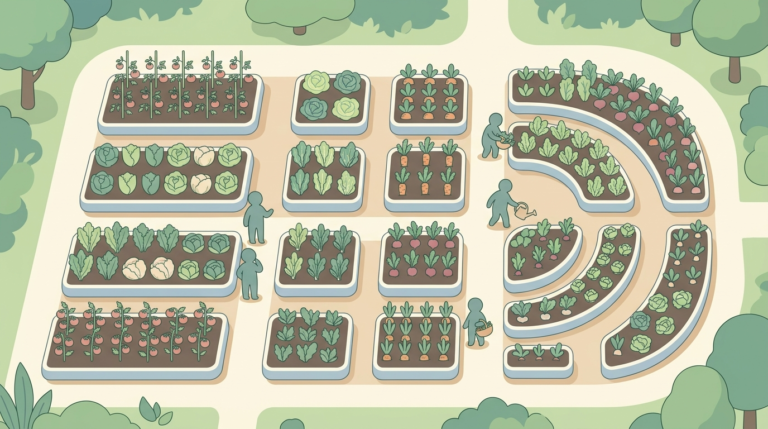
The most useful shift I made was stopping thinking of a patio garden as a scaled-down version of an in-ground plot. It’s not. It’s more like a room that happens to have plants in it. Rooms have a focal point. They have clear traffic flow. They have things at different heights so your eye moves around instead of landing flat. They aren’t just filled up.
When you walk into a room and it feels cluttered, it’s almost never because there’s too much stuff. It’s because the stuff is at the same height, same depth, same visual weight. Same thing happens on a patio with containers. Eight matching plastic pots in a row reads as clutter even if the plants are healthy. Group them by height instead — one tall element in the back or center, medium containers flanking it, something trailing or low in front — and suddenly the same eight pots feel like a decision was made.
Pick one material family and stick with it. Terracotta, galvanized metal, dark-glazed ceramic, plain black nursery pots — any of these work. Mixing all four doesn’t. Cohesion in materials is the single fastest way to make a small garden look like someone thought about it, because someone did.
What actually makes a small space look on purpose: 5 design moves
- Group containers in odd numbers. Three or five pots together reads as a composition. Two reads as symmetry that isn’t quite working. Four reads as even. The odd-number thing sounds like design-world nonsense but it actually holds up in practice.
- Add one vertical element. A cattle panel trellis, a simple obelisk, a section of welded wire tied to the fence — something that goes up. Tomatoes, cucumbers, pole beans, and most vining crops want to climb anyway. Give them something. This also frees up horizontal container space for lower-growing things.
- Create a sight line. Stand at the spot where you’ll most often look at the garden — kitchen window, back door, chair you sit in. That’s the front. Design toward that view. Everything else is secondary.
- Leave negative space. Don’t fill every inch. An empty patch of gravel, a bare corner, a gap between containers — these make the planted areas read as more abundant, not less. Overcrowding makes everything smaller visually.
- Keep the floor clean. Drip saucers that match, consistent gravel or pavers underfoot, no random bags of soil leaning against the wall. The floor of the space matters as much as what’s growing in it.
- Galvanized stock tanks from farm supply stores run $40-80 and last for years
- Plain black nursery pots (the ones plants come in) look intentional if you use them consistently
- Food-grade buckets painted the same color are cheap and hold up fine
- Whatever you use, drill drainage holes — waterlogged roots are the fastest way to lose a container plant
The year I planted 47 things in a 6×8 space
Before we moved to the farm, I had a patio that measured maybe six by eight feet on a good day. I counted once: I had 47 different plantings going in that space at peak season. Two kinds of tomatoes, three pepper varieties, four herbs, two cucumbers, some lettuce that bolted in June, a zucchini that I can only describe as a mistake, and a dozen or so other things I’ve blocked out.
It was genuinely terrible. Not just ugly — though it was that — but the plants suffered. Nothing got enough light because everything was blocking everything else. The tomatoes got fungal problems because airflow was nonexistent. The cucumbers tangled into the peppers and I couldn’t harvest anything without disturbing something else. The zucchini took over an entire corner and produced four zucchinis before I gave up and threw it in the compost.
The part I can’t fully explain is that I did almost the same thing the next year. Not 47 things, but close. I scaled back to maybe 35. The logic was that I’d learned from it, but I hadn’t actually changed the behavior. I just felt slightly more justified. The space was too small and I kept filling it because empty space felt like waste. That tension never fully went away, and I still catch myself doing it now with the raised beds out back.
Does the aesthetic stuff actually matter if the tomatoes taste fine
Ben asked me this at some point during the patio garden era and I didn’t have a good answer. Still don’t, completely.
The honest case for caring about aesthetics in a vegetable garden is partly about function — a well-designed space is easier to work in, easier to see problems in, easier to harvest from — and partly about something harder to quantify. You spend time out there. If the space feels chaotic, you avoid it. If it feels like somewhere you want to be, you go out more, you notice things earlier, you catch the aphid problem before it becomes a full infestation.
But I’ve seen plenty of productive gardens that look like organized chaos. Heirloom tomatoes threaded through hardware cloth stapled to a shed wall, chard in a cracked pot, basil in an old colander. And the food is fine. More than fine. Some of the best gardeners I know couldn’t care less how it looks.
I don’t think there’s a clean answer here. Aesthetics made me more consistent, and consistency helped the garden. But I can’t claim causation and I’m skeptical of anyone who says the way a garden looks directly improves yields in any measurable way. The tomatoes don’t know the containers match.
Beautiful containers work better than cheap ones (but sometimes don’t)
The standard advice is to buy quality terracotta, ceramic, or glazed containers because they regulate moisture better than plastic and hold up longer in the weather. That is mostly true. But the year I spent real money on Italian terracotta pots — not a huge amount, but enough to notice, maybe $80 for a set of three — was also the year two of them cracked through our Tennessee January. We don’t even get that cold. Zone 7a, and I lost two pots to a week of temps that dipped into the teens.
The cheap black plastic pots I’d had for three years, the ones I’d felt slightly embarrassed about, came through fine. They’re still out there. I use them for peppers now and they perform perfectly well. The expensive pots looked better. I don’t know that they grew anything better before they broke.
If you’re in a climate with hard freezes, bring terracotta in for winter or accept the loss rate. Alternatively, your state’s cooperative extension service often has solid guides on container selection by climate — worth looking up before spending money on something that won’t survive your winters. Self-watering containers (the kind with a reservoir at the bottom) are worth the cost if you’re inconsistent about watering. Those I’d spend money on. Plain decorative pots? Less certain.
The gravel path that accidentally happened
We had a bag of pea gravel left over from something Ben was doing — I think it was related to a drainage project that never fully got finished, which is a whole other thing — and I dumped it between two container groupings on the patio just to get it out of the way. Scraped it roughly flat with my foot and forgot about it.
It changed how the whole patio read. Suddenly the containers were sitting in something rather than just on bare concrete. The gravel defined the edges of the garden area without any border or edging. People who came over would comment on it like it had been planned. I don’t know exactly why it worked. The containers hadn’t moved. Nothing else changed. But the gravel created a surface that made the plants look like they belonged there instead of just being stored there.
I’ve since read that ground material matters a lot in small garden design, that contrast between the growing space and the floor creates visual separation — and that tracks, but I couldn’t have told you that when I dumped that gravel. It was an accident that worked. I’ve tried to replicate it deliberately twice since then and it was fine but not the same. The University of Wisconsin Extension’s horticulture resources have some useful writing on container garden layout if you want the actual principles behind it.
When caring too much about how it looks made me grow less
This one took me a while to notice. Once I got the patio looking the way I wanted it, I got conservative. I stopped trialing things. I didn’t want to put an ugly experiment plant in a spot that was working visually. I’d think about adding a new variety and then decide the container I’d put it in didn’t fit the palette.
My harvests got smaller, not because the plants failed, but because I wasn’t taking risks. Trying new things means accepting that some of them will look weird or grow wrong or need a support structure that doesn’t match the aesthetic. I’d started managing the garden for appearance instead of output, which was backward from where I’d started.
I still care how it looks. But I’ve had to build in permission to put the ugly tomato cage out when it’s what the plant needs, or try the weird squash variety even though it sprawls, or let the dill go to flower even though it gets tall and loose. The Royal Horticultural Society and similar bodies have been writing for decades about productive kitchen gardens that are also beautiful — and the common thread is that function comes first, and beauty follows from that rather than being imposed on top of it.
The one thing I’d actually tell someone starting a small container garden: design it for the version of yourself that’s tired and doesn’t want to think. If harvesting is a pain, you won’t do it. If watering is complicated, you’ll let it go too long. If the space frustrates you every time you walk into it, you’ll find reasons to stay inside. Make it easy to be in. The rest follows.