I Tried Cowboy Candy Jalapenos—Here’s Why I Make It Twice Yearly Now
I assumed canning was mostly about jars and boiling water. That was the whole mental model I had when I first started looking up a cowboy candy jalapenos canning recipe after our second summer garden overproduced so badly that I was handing peppers to anyone who made eye contact with me at the farmers market. Seemed straightforward. Slice peppers, make syrup, process jars, done. I had no idea texture was going to be the thing that derailed me.
Two years and probably fifteen batches later, I make this twice a year now—once in July when the jalapenos hit their stride, and once in September if we get a second flush. The recipe itself is not complicated. Getting it right took longer than it should have, mostly because I was ignoring the one detail that actually matters.
What You Actually Need (spoiler: it’s not much)
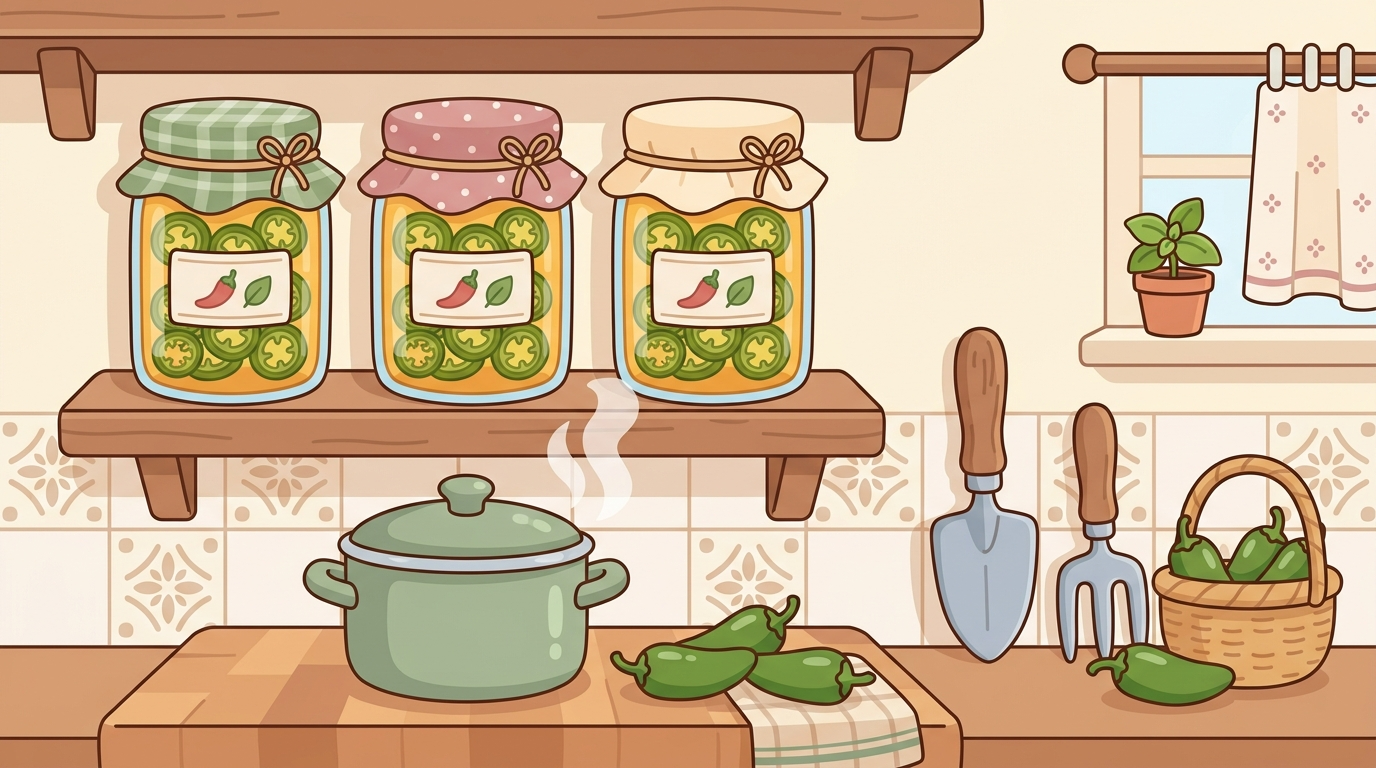
Before I get into the texture problem, here’s the equipment side of it, because this is where I wasted mental energy for no reason when I was starting out. You don’t need a pressure canner for this. Cowboy candy is a high-acid, high-sugar preserve and goes through a water bath canner just fine. The National Center for Home Food Preservation is where I cross-check anything food-safety related, and I’d recommend doing the same before your first batch.
- Water bath canner (a large stockpot with a rack works if you don’t want to buy dedicated equipment)
- Half-pint mason jars — this is a condiment, not a side dish; half-pints make sense
- New lids every time, bands can be reused
- Wide-mouth jar funnel, which costs about four dollars and is absolutely worth it
- Jar lifter — do not skip this, wet jars are slippery
- Sharp knife and a cutting board you don’t mind staining
- Nitrile gloves for slicing jalapenos, unless you enjoy explaining to your face why you touched your eye
That’s it. Ben looked at my setup the first time and said he thought we’d need more stuff. We didn’t.
The texture problem nobody explains
Almost every batch of homemade cowboy candy I saw described online was mushy. The peppers lost their bite, went soft in the jar, and ended up closer to pepper jam than something you’d want on a cracker with cream cheese. I couldn’t figure out why, because the syrup ratios were the same across every recipe I tried.
The question I kept coming back to: is it the processing time, the cut thickness, or something happening in the syrup itself? I genuinely didn’t know. Ben’s theory was that I was overcooking the peppers before they went into the jars. I told him that seemed too simple. He shrugged and went back to whatever he was building in the barn.
He was right. Partially, anyway.
How to keep cowboy candy jalapenos crispy during canning
- Cut your slices a quarter inch thick, not thinner. Thin rings turn to mush. A quarter inch holds up through processing and still absorbs the syrup without dissolving.
- Simmer the peppers in the syrup for exactly four minutes. Not six. Not eight. Four minutes, then pull them immediately with a slotted spoon into the jars. The peppers keep cooking if you leave them in the hot syrup while you’re ladling.
- Don’t pack the jars too tight. Leave a quarter inch headspace. Overpacking compresses the slices and traps steam weirdly.
- Process for ten minutes in a boiling water bath (adjusting for altitude if you’re above 1,000 feet—check the USDA guidelines or your local extension office for your specific elevation).
- Let the jars cool without touching them for twelve to twenty-four hours. I know it’s hard. Leave them alone.
The four-minute rule changed everything for me. My batches since then have had actual texture—not crunchy exactly, but not soft either. A little chew. That’s what you want.
“The peppers keep cooking if you leave them in the hot syrup while you’re ladling.” That one sentence would have saved me three bad batches.
Making the syrup (where I still second-guess myself)
The syrup is apple cider vinegar, white sugar, turmeric, celery seed, garlic powder, and cayenne. I don’t fully understand why this combination works as well as it does. The vinegar provides the acidity that makes water bath canning safe. The sugar is doing preservation work and also creating that sweet heat thing that makes cowboy candy what it is. The spices are mostly flavor, I think, though turmeric is doing something to the color that I find satisfying even if I can’t explain the chemistry.
I bring it to a boil, reduce it to a simmer, then add the peppers. Every time I make this I second-guess whether I’m simmering hot enough or too hot. My candy thermometer lives in the gadget drawer and I don’t always trust it. Still, the results have been consistent across batches, which means either I’m doing it right or the recipe is forgiving enough that it doesn’t matter. Both feel possible.
Ben thinks I should just buy a better thermometer. He’s probably right but I haven’t done it.
- Quarter-inch slices, no thinner
- Four minutes in the syrup, then out immediately
- Water bath canner, ten minutes processing
- Texture stays if you don’t overcook the peppers before jarring
- This does not dramatically save money over store-bought, but the flavor gap is real
My first batch sat in the pantry for six weeks
My first real batch didn’t seal right. Three of the six jars never pinged. I pressed down on the lids the next morning and they flexed, which meant they hadn’t sealed. I reprocessed them with new lids, which added another day of work, and two of those three still didn’t seal correctly on the second attempt.
I lost about a pound and a half of peppers, a full bottle of apple cider vinegar, and most of a morning I’d blocked out for something else. There was no useful lesson in it—I’d followed the steps, the lids were new, the jars were clean. Sometimes it just doesn’t work and you don’t know why. The two jars that survived reprocessing were fine. The others went in the trash.
The jar lifter I was using at the time was cheap and the grip kept slipping. I switched to a sturdier one—the Norpro brand, around twelve dollars—and haven’t had a sealing issue since. That might be coincidence. I’m choosing to believe it isn’t.
- Thin-sliced peppers — turned to mush every time
- Leaving peppers in the syrup while ladling — kept cooking and softened
- Cheap jar lifter with a slipping grip — contributed to sealing failures
- Reusing old lids from previous batches — not worth the risk
- Assuming the recipe would be forgiving about simmer time — it isn’t
Why twice a year feels right
I do a July batch and sometimes a September batch. July is peak pepper production out of the half-acre kitchen garden, so that one is obvious. The September batch is less certain—sometimes we get a flush, sometimes we don’t, and I end up supplementing with peppers from a neighbor who grows more than she uses.
Is doing this twice a year practical homesteading or just something I like doing? I’m not sure the distinction matters much to me at this point, but I notice I can’t fully answer it. The jars look good on the pantry shelf. We go through them faster than I expect. Pepper got into the garden shed last spring and knocked two jars off the lowest shelf, which felt like a comment on something, though I don’t know what.
Does the recipe actually save money versus store-bought?
Barely, and only if I count the peppers as free because they came from our garden. A half-pint of good cowboy candy at the farmers market runs four to six dollars. My cost per jar, counting vinegar, sugar, lids, and spices but not peppers, is probably around a dollar fifty to two dollars. So yes, cheaper. But I’m not counting my time, and each batch takes a solid two hours start to finish including cleanup.
If I bought my peppers, I’d be breaking even at best. The homesteading-saves-money thing is real in some areas and genuinely not real in others. Cowboy candy is somewhere in the middle, and mostly I make it because the flavor is better than anything I’ve bought jarred, and because I have the peppers anyway.
Whether that math works for you probably depends on how much you value two hours on a July afternoon, and what else you’d be doing with a pound of jalapenos that Pepper didn’t get to first.