Easy Canning Recipes for Beginners: Pickles—Why My First Batch Failed (And Why That Doesn’t Matter)
If you search “easy canning recipes for beginners pickles” you will get about forty different methods that contradict each other, and at least three of them will make you afraid to eat anything you’ve made. I spent two weeks reading forums before I ever bought a cucumber. That’s not a productive way to start, and I say that as someone who still has seventeen browser tabs open about fermentation versus canning and has not closed them in four months.
The actual process is less complicated than the internet makes it. Salt, vinegar, heat, sealed jar. Most of the disagreement is about ratios and method, and most of those disagreements are theoretical. Here’s what I’ve figured out after three summers of doing this with varying degrees of success on our five acres in middle Tennessee.
The One Method You Actually Need
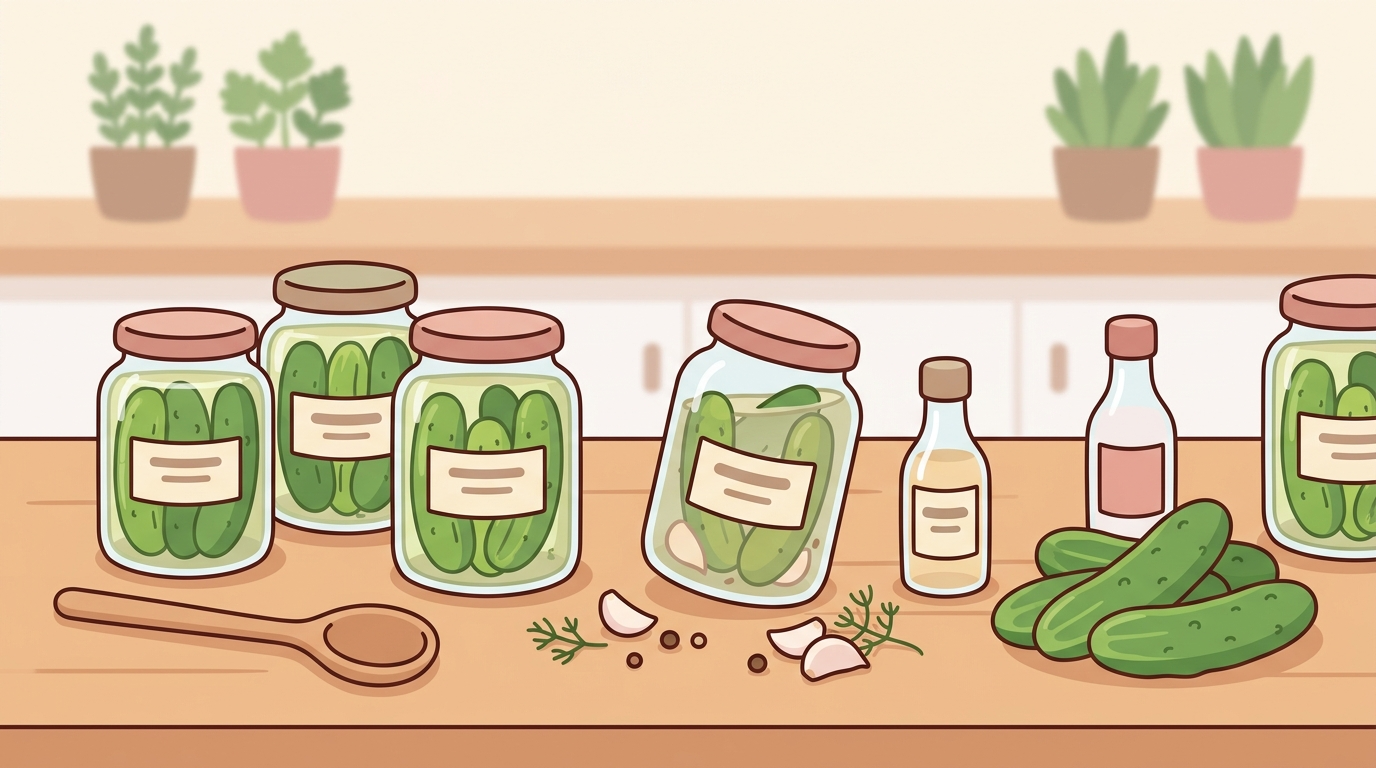
Before anything else—a TL;DR for people who just want to get into the kitchen: Use a 1:1 ratio of white vinegar to water, at least one tablespoon of non-iodized salt per pint, pack your jars tight, pour hot brine over them, and process in a water bath for ten minutes. That’s the whole thing. Everything else is refinement.
The core principle that makes pickle canning work—and that most beginner guides bury in paragraph eight—is acidity. Vinegar with at least 5% acidity is what keeps pickles safe. As long as you’re using standard grocery store white vinegar or apple cider vinegar, you’re there. Everything else is adjustable.
Steps that are not optional:
- Use vinegar that clearly states 5% acidity on the label. This is standard for grocery store vinegar. Do not use homemade vinegar for canning without testing it.
- Use non-iodized salt. Iodized salt turns pickles dark and can affect the brine. Canning salt or pickling salt costs about three dollars at Tractor Supply and one bag lasts most of a season.
- Sterilize your jars. Run them through the dishwasher on hot, or simmer them in water for ten minutes. Mason jars in a twelve-pack run around ten to thirteen dollars and they last for years.
- Use new lids every time. The bands can be reused, the flat lids cannot. A box of lids is two dollars.
- Leave a half-inch of headspace in each jar before sealing. Too little and the seal may not hold. Too much and you’ve got air in there creating problems.
The total cost for a beginner setup—a basic water bath canner, a jar lifter, a wide-mouth funnel, and a case of pint jars—runs about forty to fifty dollars. The Ball Complete Book of Home Preserving is worth having on the shelf if you’re going to do this regularly. It’s not exciting but it’s accurate.
About Vinegar, Water, and Why People Disagree
The 1:1 ratio is a starting point, not a law. Some recipes use more vinegar for a sharper pickle. Some use less water and add sugar. Some people use rice vinegar. Some use apple cider vinegar and swear it’s better for your gut, which may or may not be relevant once you’ve processed the jars in boiling water and addressed the live cultures question, but nobody online wants to fully engage with that contradiction.
What I actually want to know, and what I have not found a clean answer to, is how much flexibility there is in the water ratio before you lose the safety margin. The official guidance says don’t dilute below a certain point, but the math on what that point is isn’t spelled out in most beginner resources. It’s somewhere around 50% vinegar in the final brine. As long as you’re not going below half vinegar, you’re probably fine. But “probably fine” is doing a lot of work in that sentence, and I want someone to just say it plainly instead of hiding behind recipe compliance.
Ben thinks I overthink this. He’s probably right, and I hate that.
What You Absolutely Cannot Mess Up
There are actually very few things that create real risk in pickle canning, which is useful to know because it narrows down where to pay attention.
- The vinegar acidity. Already covered. Don’t skip this check.
- The seal. After processing, the lids should be concave and firm. Press the center—if it flexes and pops back up, that jar didn’t seal. Refrigerate it and use it within two weeks.
- Clean jars and equipment. Not sterile-surgery clean. Clean like you’d use for a meal you cared about. Residue in jars or on equipment creates problems.
- Processing time. For pint jars of cucumber pickles at Tennessee elevations (we’re not at altitude here, so no adjustment needed), ten minutes in a rolling boil. Don’t shortchange this.
- Let the jars rest. Don’t mess with them for twelve to twenty-four hours after processing. The sealing is still happening. I have violated this repeatedly and will discuss that in a moment.
That Summer I Opened Every Jar Too Early
Our second summer here, I put up about thirty pints of pickles across three weekends in July. The cucumbers were coming in faster than I could use them, the kitchen smelled like a deli, and I was feeling competent for the first time about something food preservation related.
I also opened six jars within the first forty-eight hours because I wanted to check the texture, or taste the brine, or just confirm that the garlic I’d added was visible through the glass. Ben watched me do this with the expression of someone who has decided not to say anything, which is worse than saying something.
“Those were probably fine,” he said finally.
“I know they were fine,” I said.
“So you don’t actually want my opinion.”
“I don’t need your opinion. I opened six jars early, the pickles were slightly softer than they should have been, and I ate all of them over the next week without any problem.”
He went back to the porch project he was working on, which at that point was some kind of cold frame situation that had expanded in scope three times since he’d started. The pickles I’d opened early were genuinely fine but also genuinely soft—not a food safety issue, just a texture one. The ones I left alone for two full weeks were better. I don’t know exactly where in that window the texture difference happens. I stopped testing because I was eating all my own test subjects before I could compare them.
None of this resolved into a lesson. I still open jars too early sometimes. Hank was sitting on the porch railing that whole afternoon, watching me through the kitchen window like he had somewhere better to be.
- Opening jars within 24 hours—pickles were noticeably softer
- Using iodized table salt my first batch—brine turned dark and murky (safe, just ugly)
- Packing jars too loosely—cucumbers floated and the top ones stayed rubbery
- Not trimming the blossom end off the cucumbers—supposed to contribute to soft pickles, and honestly my softest batches were the ones where I skipped this
- Buying a cheap jar lifter—it dropped a jar and that was the end of that jar lifter
People Say You Can’t Skip the Water Bath (They’re Kind of Wrong)
The “people say you can’t skip the water bath” thing needs more nuance than it usually gets. The official guidance from the USDA and the National Center for Home Food Preservation says to process pickles in a water bath canner. That guidance is accurate and I’m not arguing with it.
But refrigerator pickles are a thing. They use the same brine, skip the processing, and last for months in the refrigerator. Plenty of people have made quick-process pickles—poured hot brine over cucumbers, sealed the jar, let the heat create a partial vacuum—for decades without a water bath, and the jars have sealed and the pickles have been fine. The acidity is the safety element. The water bath adds shelf stability and a more reliable seal, but it’s not the only thing standing between you and a problem.
The risk with skipping processing is inconsistent seals and shorter shelf life, not botulism—because the acidity in a properly made pickle brine creates an environment where Clostridium botulinum doesn’t survive. This is why pickles are a good beginner canning project. It’s also why the earlier section about not being able to mess up the seal is complicated by this section, and I’m leaving that tension there because that’s actually how it works.
For what it’s worth, I process all my jars because I don’t have reliable refrigerator space for thirty pints of pickles, and I want the shelf stability. But I made refrigerator pickles for a full year before I bought a canner, and none of us got sick.
The Spice Thing
Dill is obvious. Black peppercorns, garlic, red pepper flakes—these are the things everyone adds. I’ve used mustard seed, coriander, bay leaves, and one experimental batch that had too much horseradish in it. I grow dill in the herb spiral by the greenhouse, and in a good summer I have more than I can use.
What I’ve noticed is that the spices I use from my own garden don’t taste dramatically different from dried spices in a jar, at least not in the final pickle after processing. This is probably not what anyone growing their own dill wants to hear. The fresh dill smells better in the jar before it goes into the canner. After ten minutes in boiling water, it’s hard to tell.
I’ve never measured spices for pickles. I put in what seems like enough and it’s always been fine. That is not helpful prescriptive advice but it is honest.
How to Make Easy Pickle Recipes Without Overthinking the Recipe
The thing about easy canning for beginners is that the recipe matters less than understanding the two or three things that actually need to be correct—primarily that vinegar-to-water ratio and the salt amount. Once you have those anchored, you can change almost everything else.
Different cucumbers work differently. Kirby cucumbers hold their texture better than slicing cucumbers. I’ve used both because I grow both and I’m not throwing cucumbers away when the Kirbys run out. The texture is different but both are good.
You can do whole cucumbers, spears, or slices. Slices process faster because there’s more surface area. Whole cucumbers sometimes stay crunchier. Spears fit in jars in an annoying way and I always end up with one that won’t stand up straight.
The flexibility is the actual skill here. Once you know what can’t move, you stop being precious about the parts that can. That’s true for canning and also for most things on this property, though it took me longer to figure it out for canning than it did for, say, accepting that Pepper will find a way out of any fence Ben builds regardless of how much time he spends on it.
Why I Still Don’t Know If I’m Doing This Right
Three summers in, I have shelves of pickles that everyone who has eaten them has said are good. My jars seal reliably. I’ve had two failures—one batch of soft pickles from my first year that I ate anyway, and one jar that didn’t seal that I caught immediately and refrigerated.
I also still read forum threads about pickle canning at eleven at night, which is where I learned that the blossom-end trimming thing matters, and also where I learned that half the people saying it matters can’t cite a source for why. Ben does not do this. He made one batch of refrigerator pickles last August, didn’t measure anything, and they were better than mine. I have not fully processed this.
There’s a version of this article where I wrap it up by saying I found my process and I trust it now. That’s not where I actually am. I trust it enough to eat what I make and serve it to people. I don’t trust it enough to stop reading about it, and I’m not sure that’s a problem I need to solve. The pickles keep working. Whether I’m doing it right is maybe a different question than whether it’s working.
The cucumbers from the garden will come in again in late June, right around the same time everything else needs attention at once, and I’ll set up the canner on the outdoor burner and do it again, and probably open a jar too early, and probably be fine.