How We Handle Small Backyard Vegetable Garden Layouts (After Getting It Wrong)
Everyone told us to start small. “You don’t need a big garden your first year,” said people on forums, neighbors, the woman at the feed store who somehow always has an opinion. And we did start small. The problem is that “small” doesn’t mean much when you have no idea what small backyard vegetable garden layouts actually require to function. We had a rough square of cleared ground, some lumber Ben had leftover from a different project, and a seed catalog we’d been dog-earing since February. We planted based on what we wanted to eat, not based on what the ground could actually support. That first summer was instructive, mostly in how many things can fail simultaneously.
We’re in Zone 7a, which means our last frost in Middle Tennessee usually lands somewhere around mid-April, sometimes later. That window matters more than I understood when we were starting out. Everything I’m describing here applies to gardens in a similar range — if you’re further north or south, some of the timing will shift, but the layout logic mostly holds.
Start with your shade map, not your seed catalog
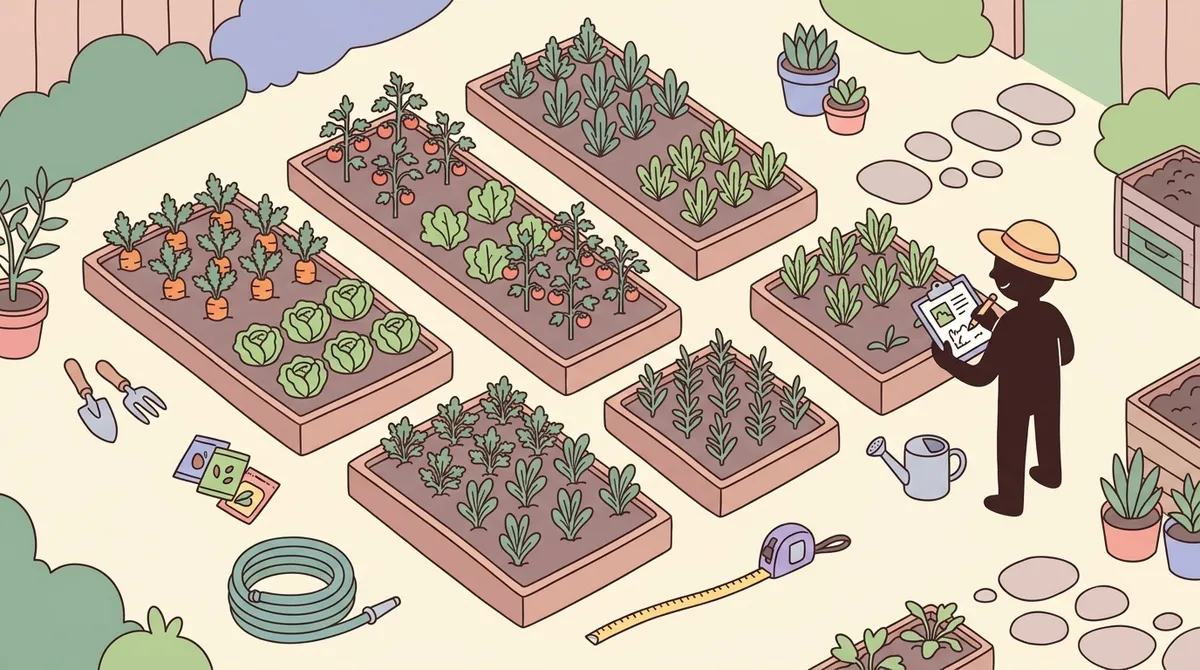
The seed catalog is more interesting. I know. But the single most useful thing we did — in our second year, not our first — was spend two weeks just watching where the sun landed before we planted anything. I drew a rough sketch of the raised beds and the kitchen garden border and marked shadows at 8am, noon, and 4pm for about ten days. It took maybe five minutes a day and the results were annoying because they showed me how wrong our first-year layout had been.
The east side of the garden gets morning shade from the tree line — our property runs into woods on two sides — and then opens up by mid-morning. The west beds get full afternoon sun until the light drops, which in July means they’re punishing. I’d put tomatoes on the east side because that’s where the soil looked best. I should have put them on the west. The peppers that needed consistent heat were in partial shade half the day. It sounds like a small mistake and then you see the harvest numbers and it stops feeling small.
Do the shade map before you buy a single seed packet. In Tennessee, start observing in late February if you’re planting in spring. Give yourself at least a week of data, two is better. It costs nothing except the time it takes to walk out there three times a day.
Vertical doesn’t mean trellises everywhere
The internet will tell you to grow vertical to save space. Cattle panels from Tractor Supply, t-posts, DIY A-frame trellises — all of it shows up in every layout guide as the obvious solution to a small plot. Ben read a forum post about vertical growing and spent part of a March weekend building a trellis structure that was, honestly, impressive. Eight feet tall. Solid. He was proud of it.
We put cucumbers on it. The cucumbers did great. The trellis blocked afternoon light from the bed directly behind it for most of the season, which happened to be the bed with our lettuces and herbs. I hadn’t mapped that shadow because I built the shadow map before Ben built the trellis. So that was a sequencing problem I created for myself.
The actual rule, which I’ve since had to accept because Ben was right about it when I was arguing for more trellises, is that vertical structures only help if you’ve thought through what they shade. In a small plot, anything taller than three feet is going to affect something behind it. That’s not an argument against going vertical — the cattle panel cucumber setup from Tractor Supply (around $25 a panel) was genuinely worth it — it’s an argument for placing those structures on the north side of your beds so the shadow falls outside the growing area.
What actually grows in 4 square feet
This is the question I kept asking when we were redesigning the beds and nobody gave me a straight answer. So here’s what we’ve actually grown in a single 2×2 foot area or across a small 4-square-foot section, with realistic expectations:
- Lettuce: You can cut-and-come-again from a 4-square-foot section through most of spring. We seed densely using Johnnys Selected Seeds loose-leaf mixes and get six to eight weeks of steady harvests before heat bolts them. Succession plant every three weeks starting six weeks before last frost.
- Radishes: 16 radishes in a 4-square-foot space, direct sown. They’re done in 25-30 days. We treat them as gap fillers between slower crops.
- Bush beans: One variety we’ve had luck with is Provider from Baker Creek — you can fit about 9 plants in 4 square feet and get two to three pickings before they’re done. Direct sow after last frost.
- One pepper plant: Just one, with a cage or stake. We tried two in a 4-square-foot section and they crowded each other and both produced less than a single plant had the year before.
- Kale or Swiss chard: Two to three plants per 4 square feet. Start seeds indoors 6 weeks before last frost, transplant out after. They’ll produce from late spring through fall if you cut the outer leaves.
- Cherry tomatoes: One indeterminate plant needs more like 6-9 square feet once it gets going. Don’t try to fit two in 4 square feet. We learned this the hard way and ended up with a tangle that produced maybe half what one well-spaced plant would have.
- Baker Creek Heirloom Seeds — great variety selection, reliable germination
- Johnny’s Selected Seeds — more expensive but worth it for things like lettuce mixes and pepper starts
- Territorial Seed Company — good for varieties suited to the Southeast
- The Square Foot Gardening book by Mel Bartholomew is still the clearest layout reference we’ve found, cost about $20
The watering contradiction we never resolved
Ben set up a drip irrigation system in our second year. It took a full Saturday, about $80 in parts from the hardware store, and it works. Water goes directly to the root zone, less evaporation, timer keeps it consistent. Every reason to use it is a real reason.
We still hand-water half the garden most mornings.
I don’t have a good explanation for this. Part of it is that walking the beds while watering is also when I notice things — an insect problem starting, a plant that’s stressed, something that needs staking. Part of it is that the drip system doesn’t reach the containers or the herb spiral. Part of it is probably just habit. Ben says I’m wasting time and that I could just walk the beds without a hose in my hand. That’s technically true. The drip system probably does use less water overall. But I haven’t been able to verify that because I don’t have a way to measure what I use hand-watering versus what the drip lines use, and honestly I haven’t tried very hard to figure it out. We’ve been running both systems for a full season now and I still don’t know which one actually produces better results.
Why we ripped out half of it in July
In our second summer, we grew a lot of things we didn’t end up using. This is the failure I kept not writing about because there’s no good version of the story.
We planted two varieties of eggplant because they were in the catalog and looked good. Neither Ben nor I actually cook eggplant with any regularity. We grew it, it produced, we gave some away at the farmers market and left the rest on the plant until it went bad. We grew a winter squash variety called Jarrahdale because the color was interesting. The vines took over a significant portion of a bed, shaded out two pepper plants I’d been coaxing along since March, and at the end of it we had six squash sitting on the porch that we ate maybe two of before they went soft. We planted a row of turnips because I read they were good for the soil. I don’t like turnips. Ben doesn’t like turnips. I don’t know what I was thinking.
In July I pulled out the eggplant, the remaining squash vines, and the turnips. That’s roughly half of one raised bed and part of the kitchen garden border. I replanted with a fast-maturing bush bean and some fall lettuce starts. It was too late in the season for those to do much. The bed was mostly empty until frost.
The fix for next year was simple: only grow things we already cook. But that didn’t help with the season we’d already lost.
The spreadsheet situation
I kept a yield-and-cost tracking spreadsheet for about eight months. I logged what we spent on seeds, amendments, and supplies, and I tracked harvest weights using a kitchen scale. I have a lot of data. It did not make me a better gardener. What it did was give me specific numbers to feel bad about — I know we spent roughly $340 on the kitchen garden in year two and the yield, priced at farmers market rates, came out to about $290. That’s a $50 loss that I could have estimated without a spreadsheet. The tracking also made me anxious about succession planting gaps in a way that paralyzed me instead of helping me plan. I still keep the spreadsheet. I don’t know why.
Does container placement actually matter?
I’ve been moving our larger containers around the porch and the edge of the kitchen garden based on sun exposure as the season shifts. In spring the light angle is different than in July, and some spots that are shaded in summer are workable in April. Whether this actually improves yield is something I’ve been trying to figure out for two seasons and I still can’t tell. The containers with herbs seem fine wherever I put them. The pepper I moved to a sunnier porch spot in June did seem to do better than the one I left in place, but I also watered them differently and used different potting mixes, so I can’t point to placement as the variable. Moving large containers is also just annoying. Ben thinks I should leave them where they are and I think he’s probably right, which is its own kind of frustrating.
What I do know is that three years in, I spend more time observing the garden than I did in year one and I produce more food with less wasted space. Whether that’s because of the layout changes or just general experience, I honestly can’t say. Probably both. The layout work matters, but it doesn’t override knowing your specific ground, and that knowledge takes longer than one season to build. We still got the eggplant wrong after all of it.